Installation: THE MARKET
September 8, 2013 § Leave a comment
Gallery of Photography, Dublin 24 August – 1 october 2013
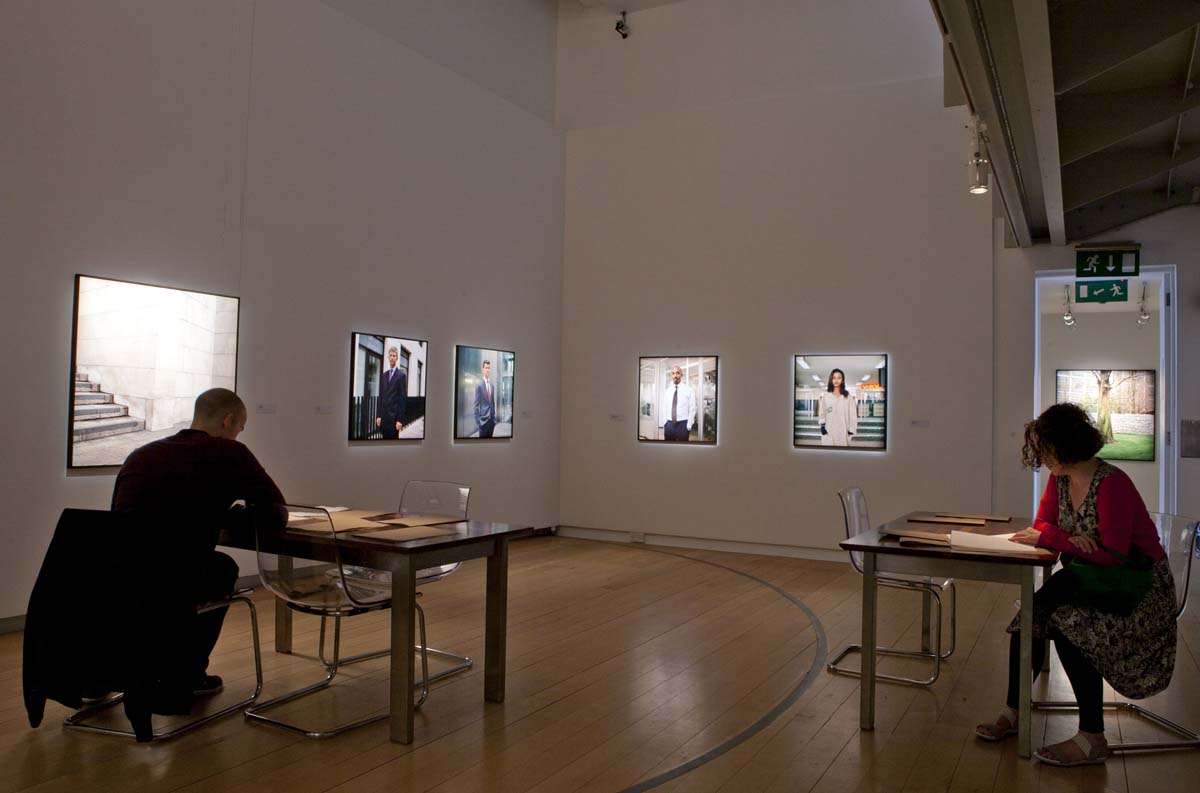
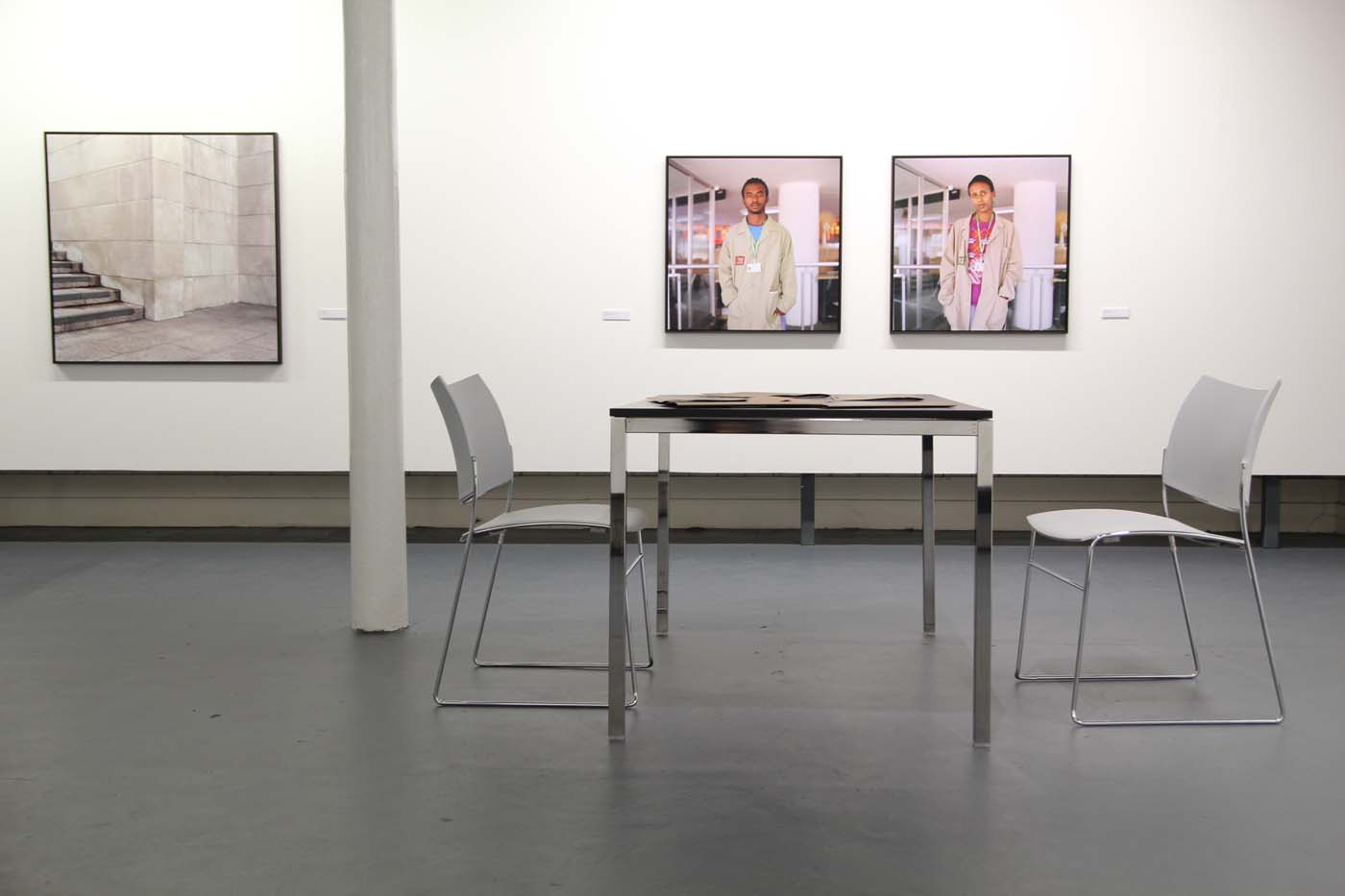
(installation photograph by Jamin Keogh)
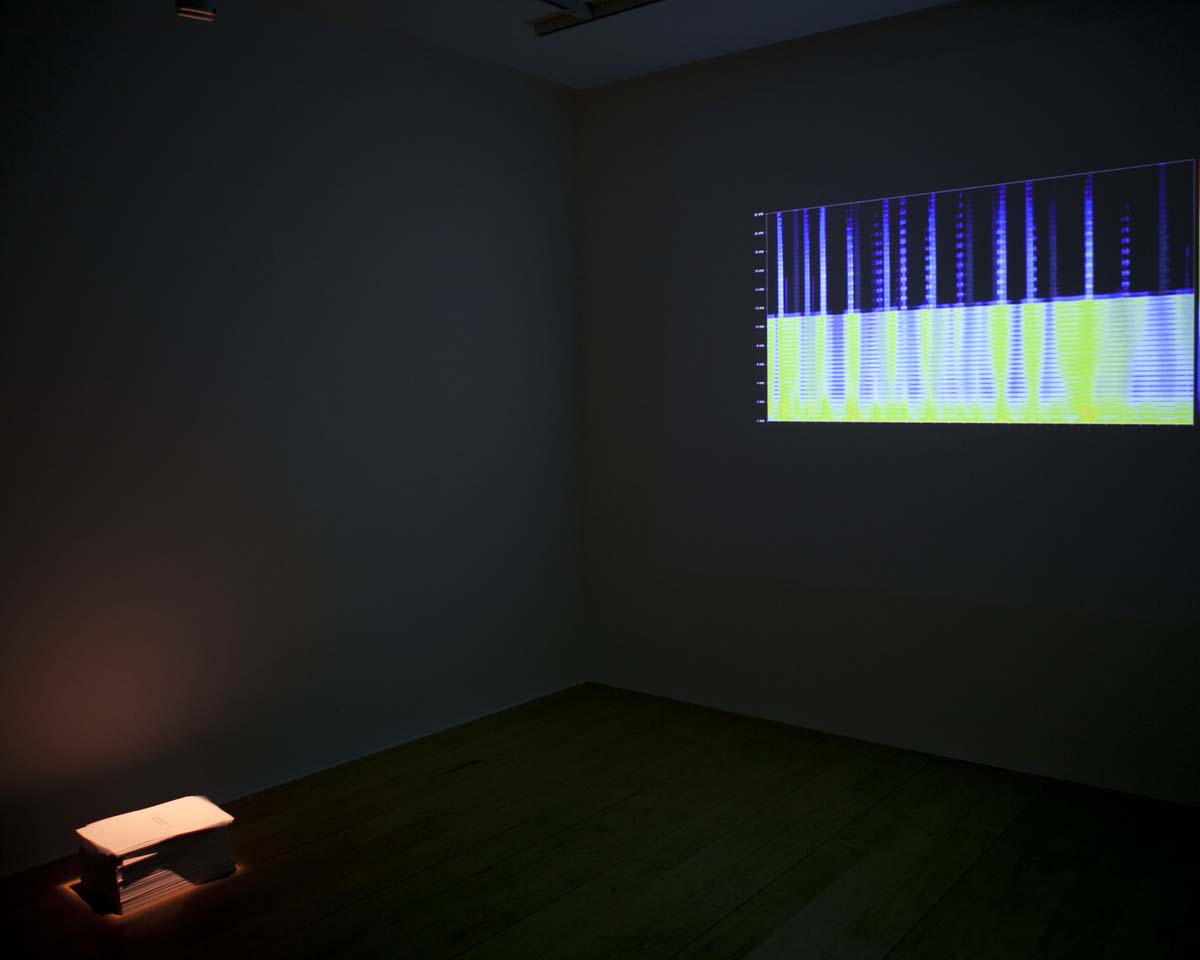
(installation photograph by Jamin Keogh)

(installation photograph by Jamin Keogh)
The image above of part of the installation titled The Normalisation of Deviance shows Spectrograms, a moving visual representation of the soundscape of the installation. The soundscape has been generated through the data generated through the use of an algorithm to identify how often the Irish Minister for Finance has used the word Market or Markets in his public speeches since taking office.
(installation photograph by Jamin Keogh)
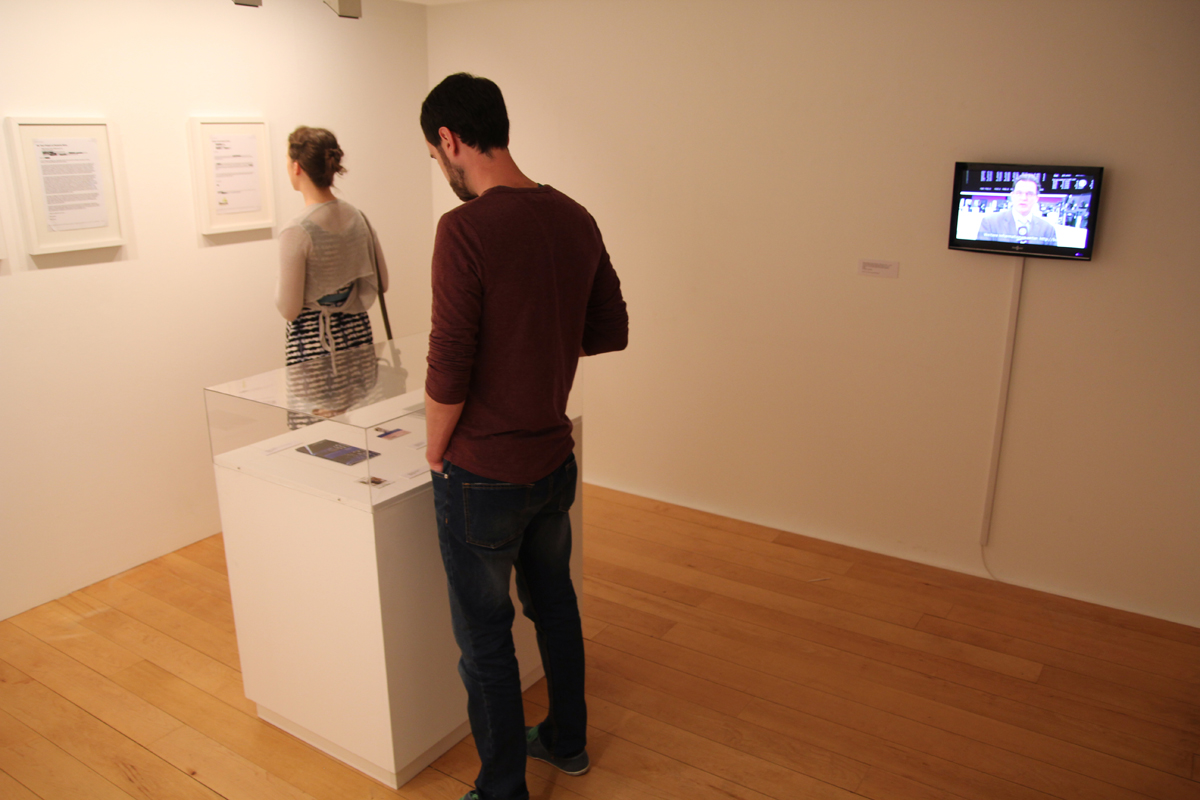
(installation photograph by Jamin Keogh)
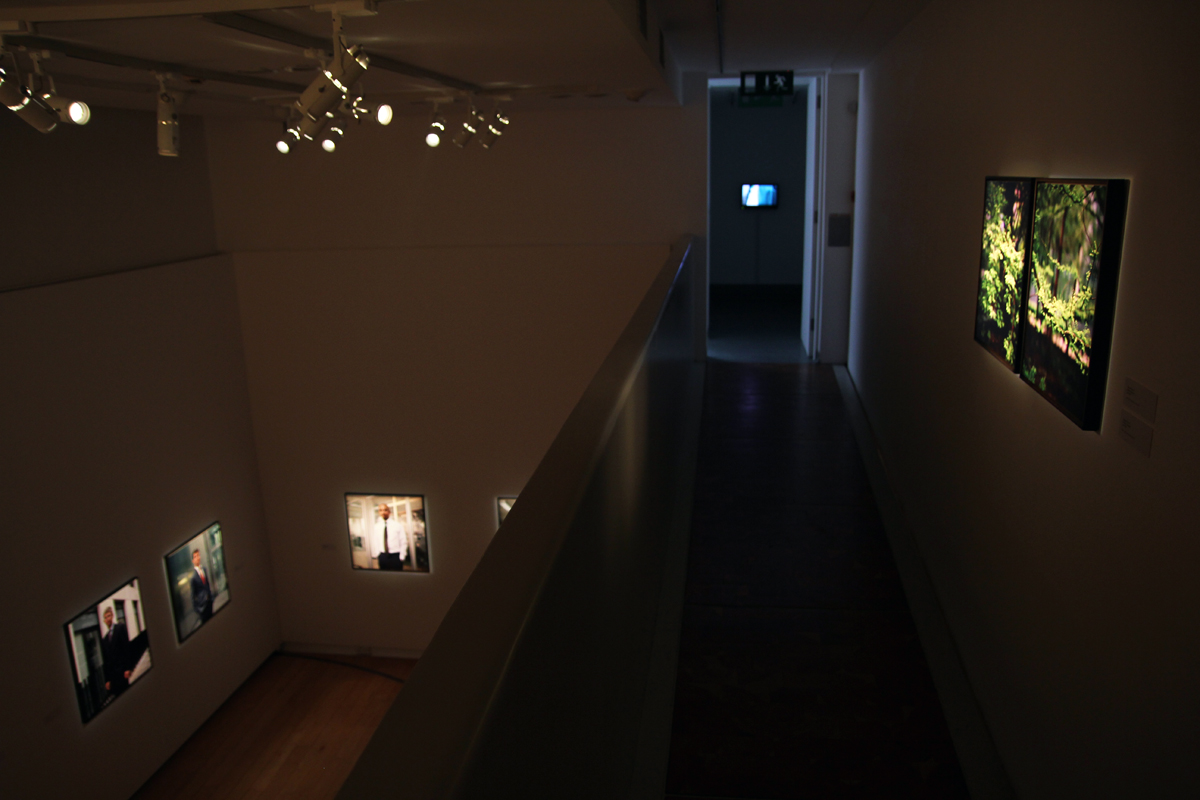
(installation photograph by Jamin Keogh)
Belfast Exposed 29 August – 11 October
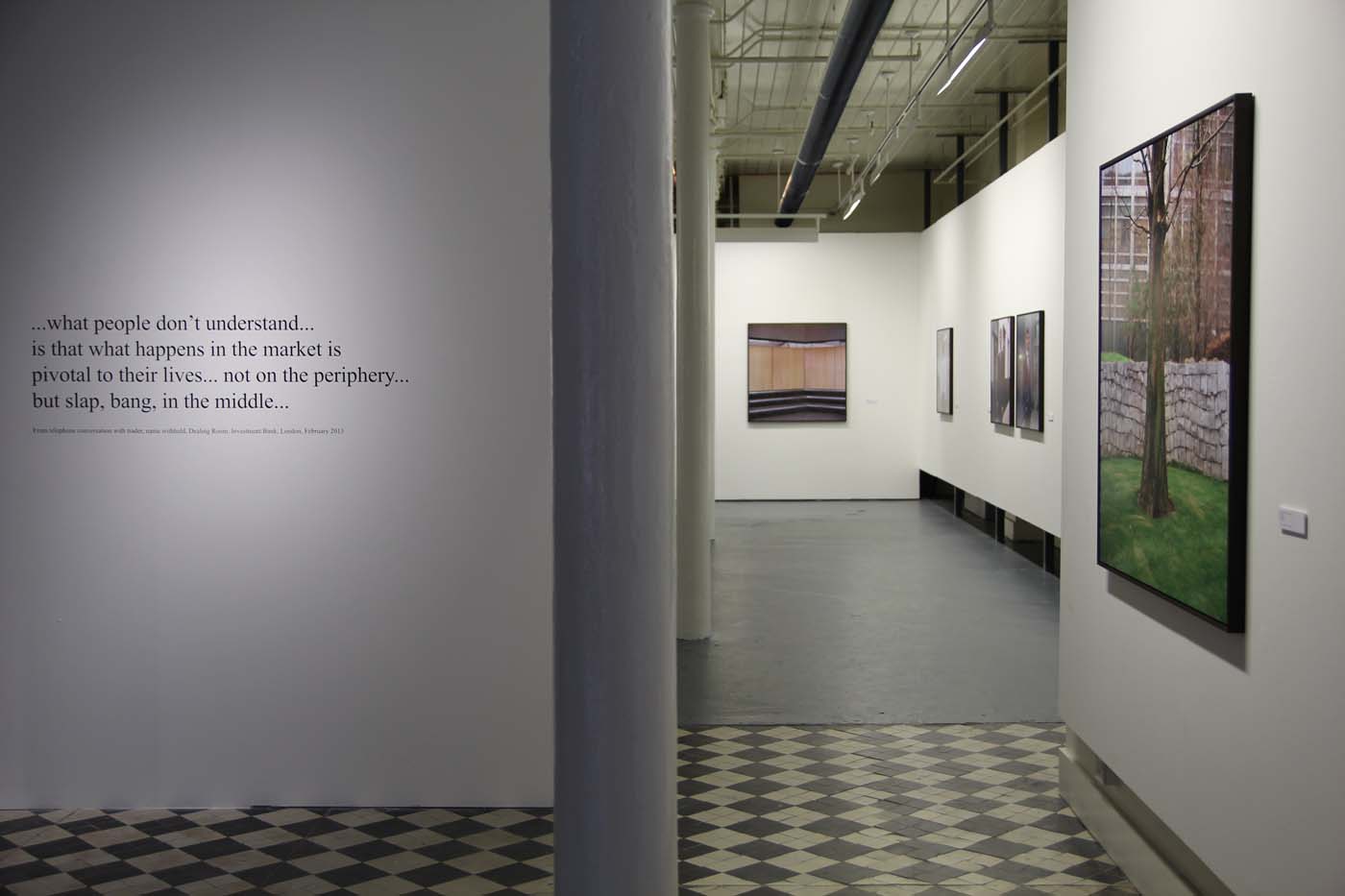
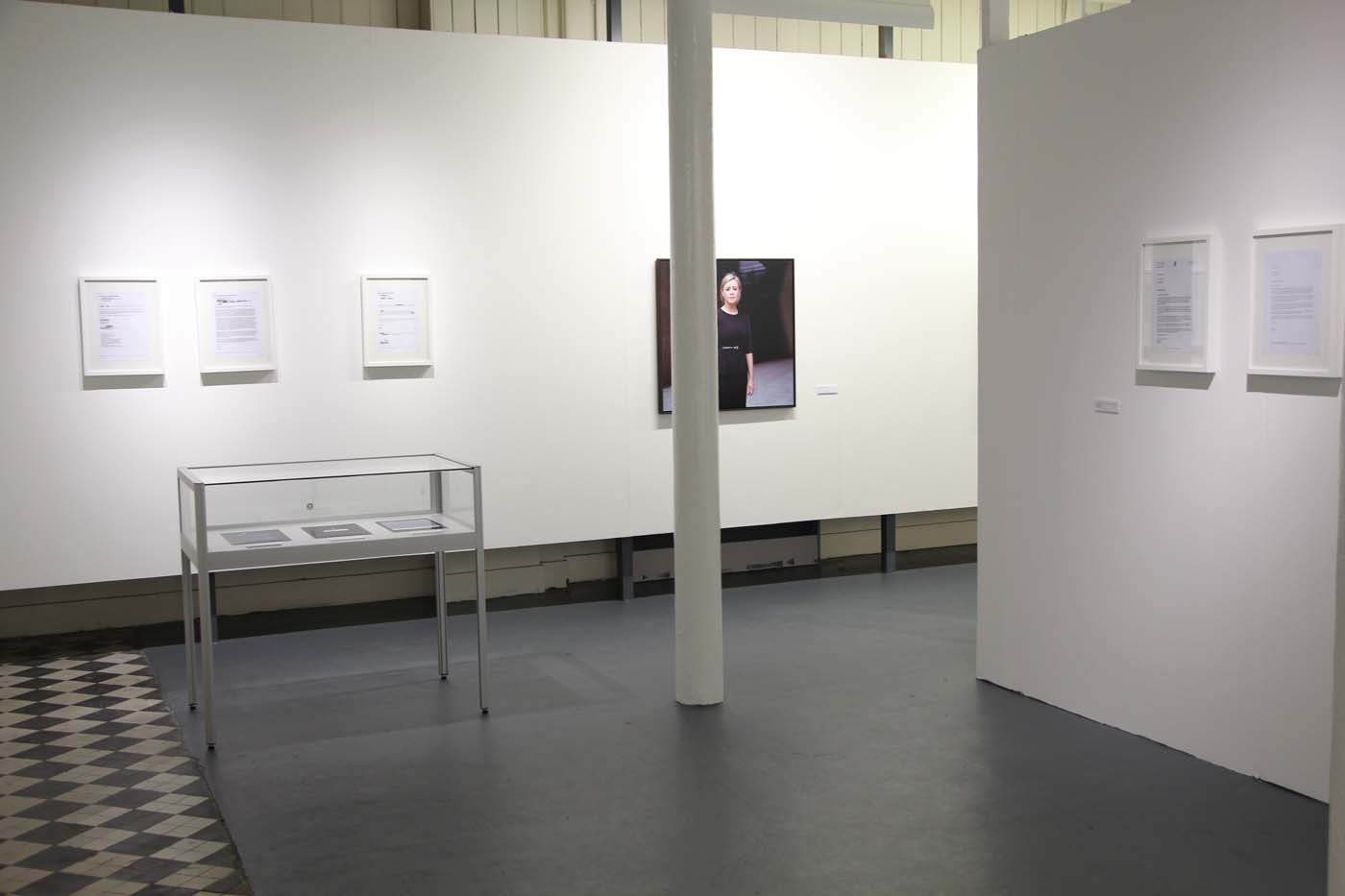
The installation is similarly framed by the soundscape generated through the data generated by an algorithm identifying the application of the words Market or Markets by the British Chancellor of the Exchequer in his public speeches since taking office.
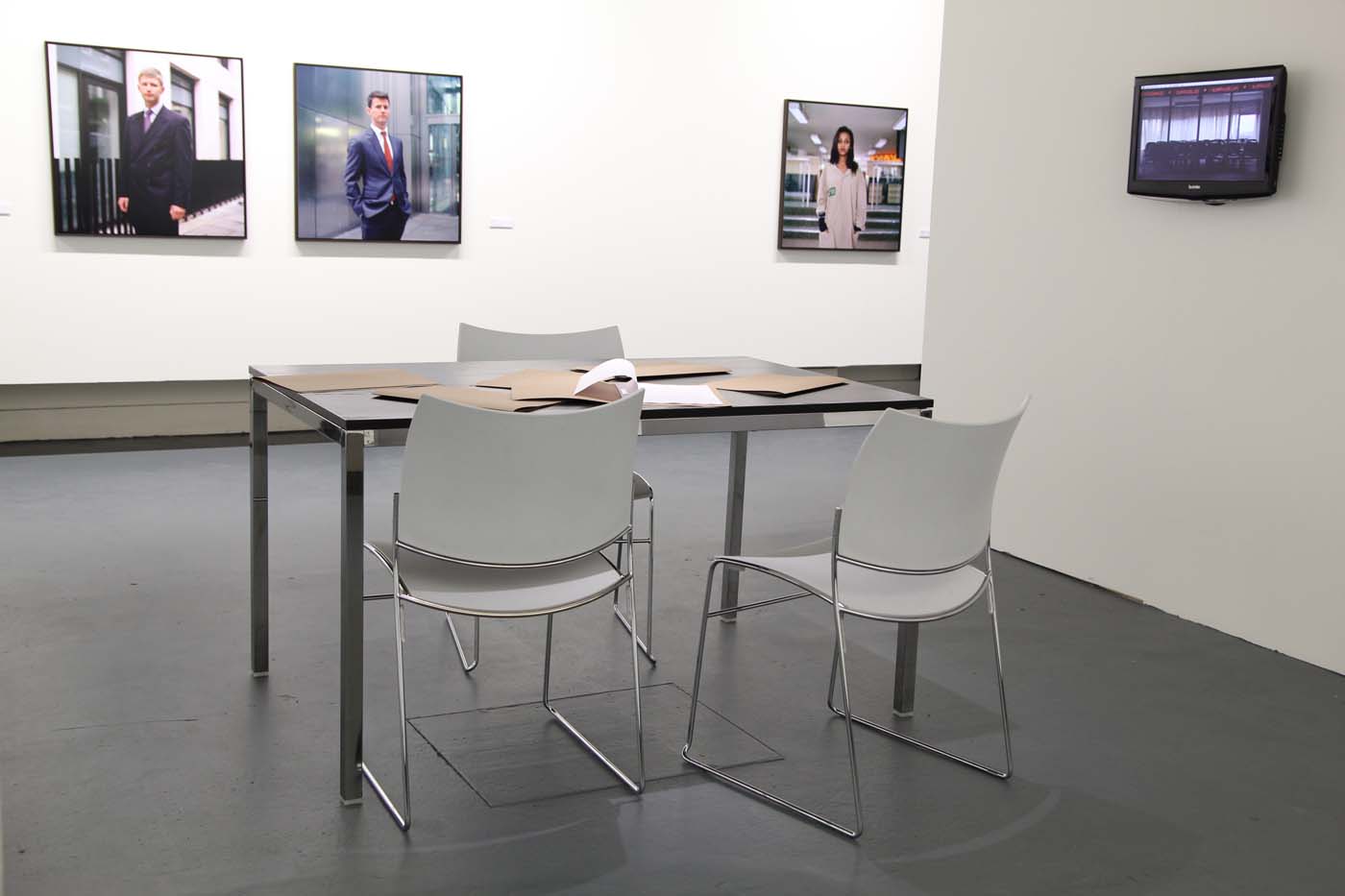

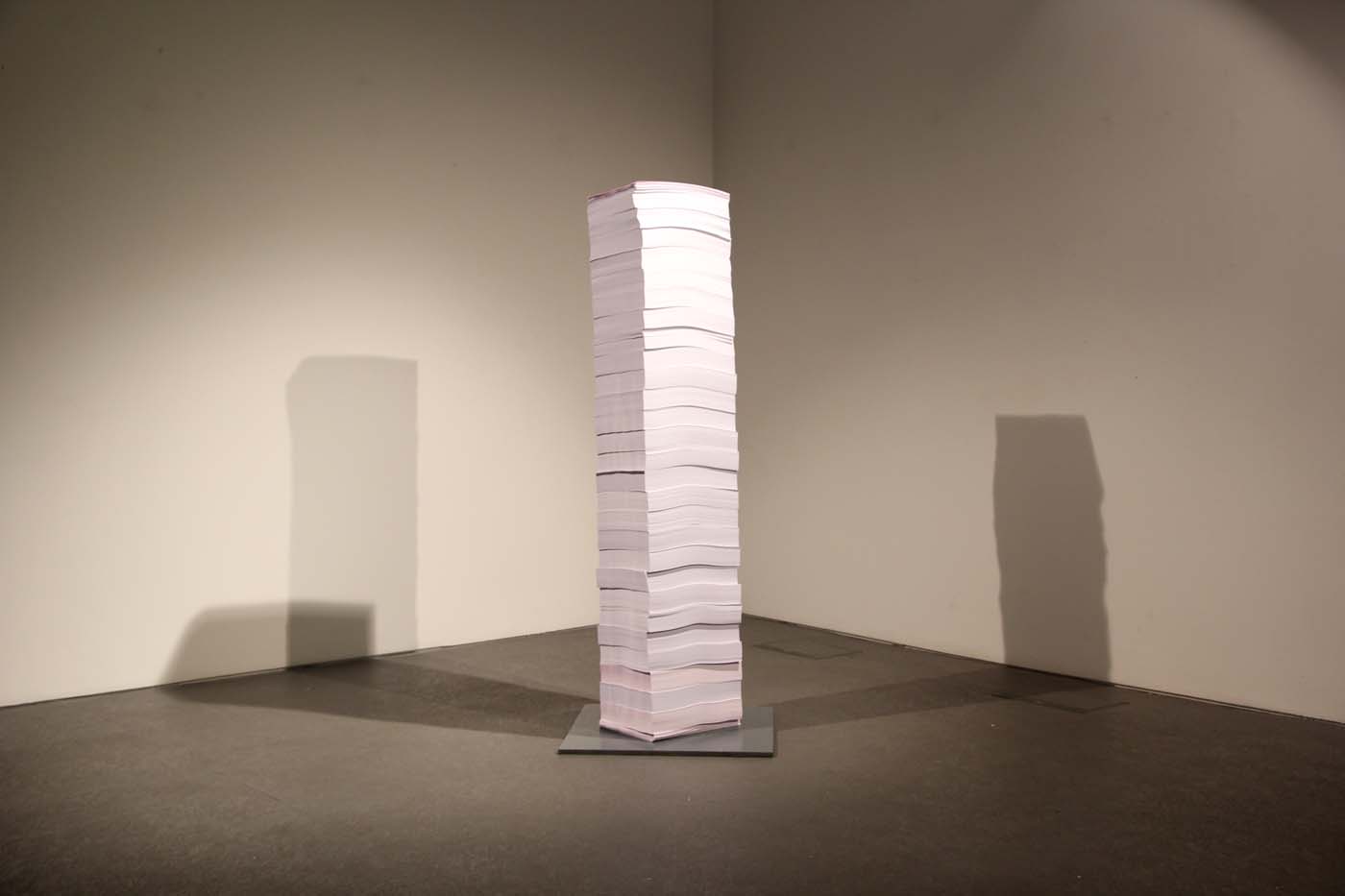
The installation image below shows the 6 feet high stack of A4 paper also titled The Normalisation of Deviance as part of the installation. This equates to the findings by a Chicago-based researcher of the number of global positions taken through the use of algorithms on one stock in one nanosecond. The total was 14,000 and equates to this amount of paper if this data was printed out. On the pages facing up is the quote:
…what people don’t understand… is that what happens in the market is pivotal to their lives… not on the periphery…but slap, bang, in the middle…
(From telephone conversation with trader, name withheld, Dealing Room, Investment Bank, London, February 2013
THE MARKET @ Belfast Exposed
August 29, 2013 § Leave a comment
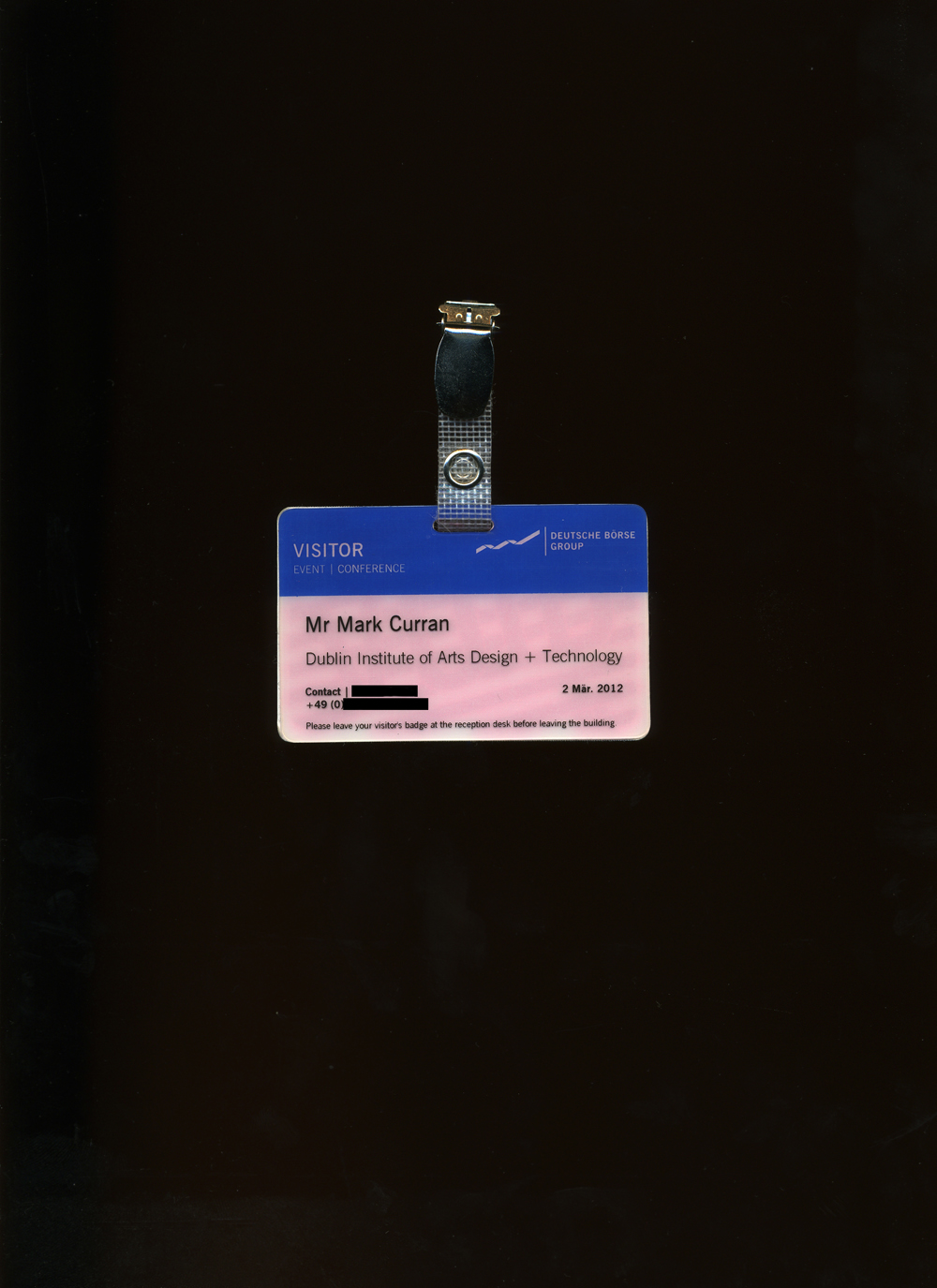
Void Visitors Pass, Eschborn, Frankfurt, Germany, March 2012
THE MARKET
Further information available here.
THE MARKET @ Gallery of Photography, Dublin
August 22, 2013 § Leave a comment
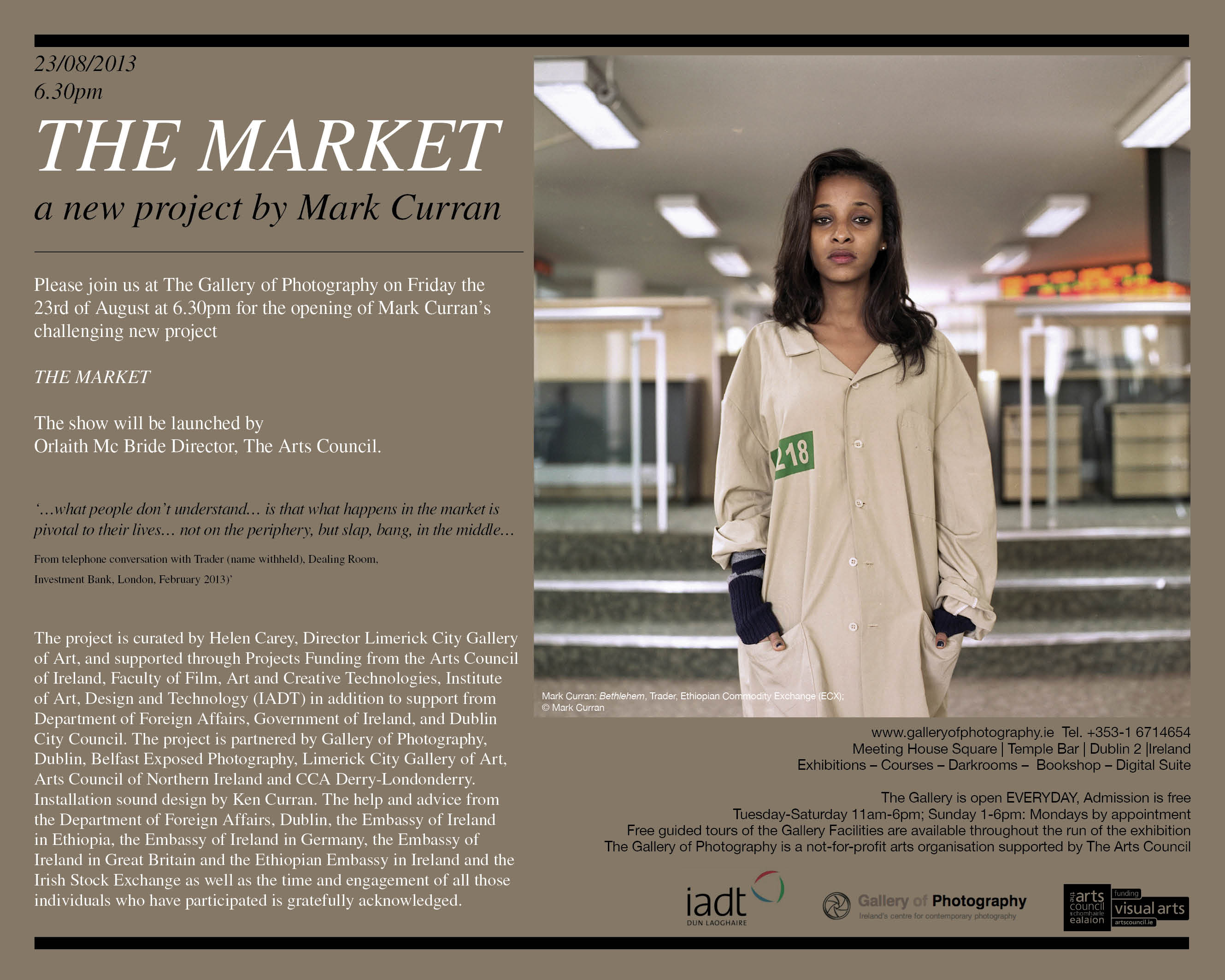
The installation of THE MARKET by Mark Curran, curated by Helen Carey, on the function and condition of the global stock and commodity markets will be opened this Friday, August 23rd at 6.30pm by Orlaith McBride, Director of the Arts Council of Ireland at the Gallery of Photography, Dublin.
The show continues until October 1st. (Algorithm and sound design by Ken Curran). Further information here.
LABOUR & LOCKOUT: ‘you take my life when you do take the means whereby I live’
August 2, 2013 § Leave a comment
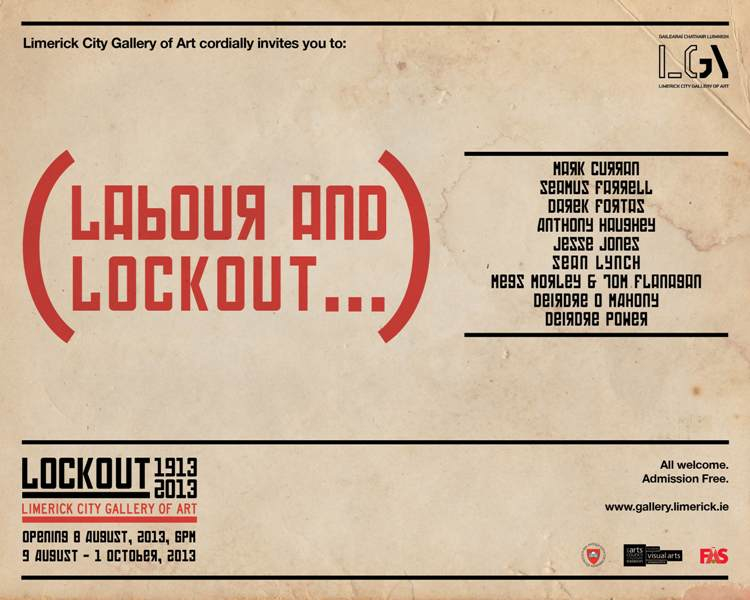
Opening Thursday, August 8th at the Limerick City Gallery of Art, this group show curated by Helen Carey, employs the context of the centenary of the 1913 Dublin Lockout as a means to reflect and address its significance for the present. The show continues until October 1st.
Artists include Deirdre O’Mahony, Anthony Haughey, Deirdre Power, Darek Fortas, Jesse Jones, Sean Lynch, Seamus Farrell, Megs Morley & Tom Flanagan and Mark Curran.
In addition, from the 26-28 September, the research collective, Future State, is collaborating with Goldsmiths, University of London and Limerick City Gallery of Art to host Land Labour Capital, a three-day event of film screenings, artist talks, seminars and workshops related to the exhibition theme. Keynote speakers will include, Deirdre O’Mahony, Professor Nicholas Mirzoeff, Dr Angela Dimitrakaki and Mark Curran.
Full details can be found here.
UNCERTAIN STATE – Temple Bar Photography Summer School
June 25, 2013 § Leave a comment
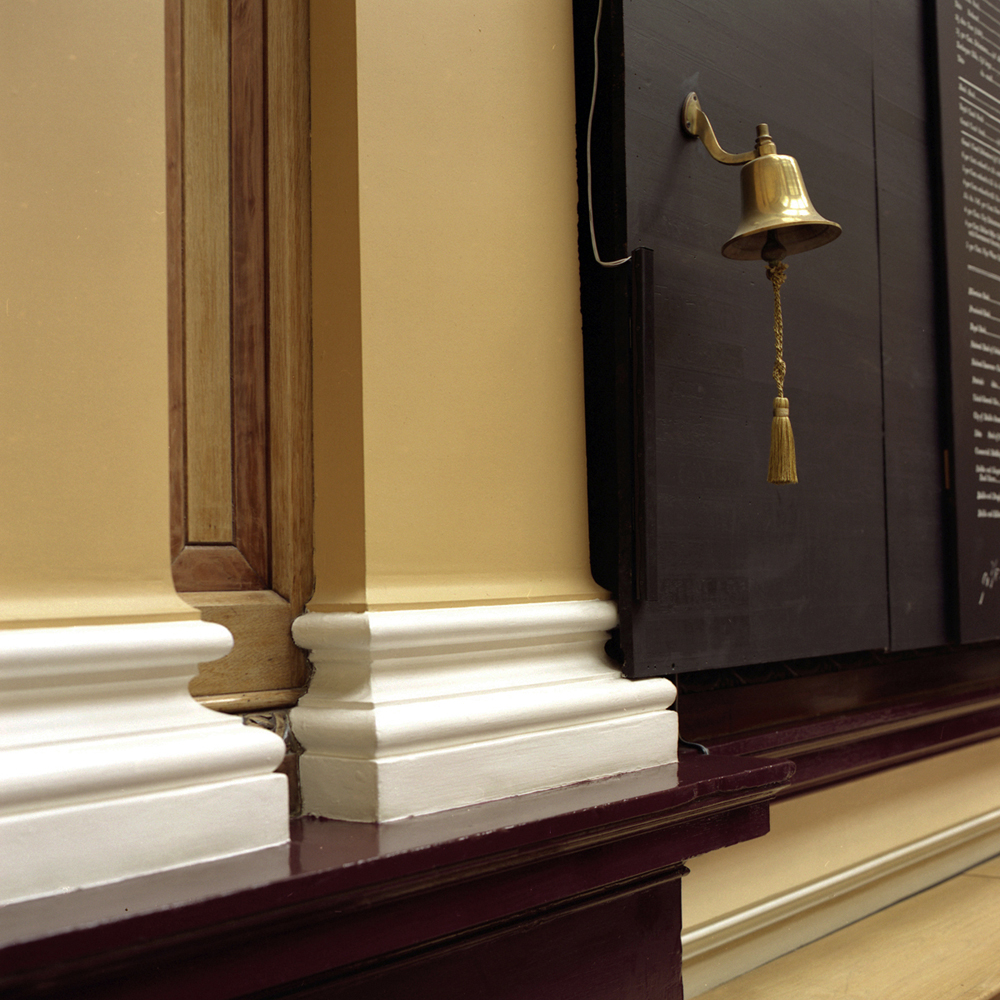
Bell, Decommissioned Trading Floor
Irish Stock Exchange (ISE)
July, 2012 Dublin, Ireland
from THE MARKET, a project by Mark Curran
The inaugural Temple Bar Photography Summer School takes place this Friday and Saturday, June 28 and 29 at Dublin’s Project Arts Centre. The two-day programme will explore how contemporary photographers are responding to this moment of uncertainty and instability in contemporary Ireland. The event further links in with the forthcoming group exhibition at the Gallery of Photography, titled Uncertain State. The accompanying text for the exhibition questions:
How is photography responding to the crisis? Uncertain State looks at how photographic artists are representing this period of austerity and uncertainty in Ireland. Their work addresses important issues at the heart of where we are now: contested and hidden histories, effects of the global financial crisis and the radically altered social and physical landscapes. The ten artists in Uncertain State go beyond surface readings to reflect the emerging concerns in post-Celtic Tiger Ireland: the treatment of asylum seekers; institutional abuse; sexual abuse; emigration; the legacy of the property crash; identity; disadvantage & marginalisation; and the legacy of conflict.
Such themes will be the subject this weekend and will include the following leading artists, academics, historians and writers:
Dr. Luke Gibbons (Academic and Writer, NUIM)
Val Connor (Curator, NWCI Legacy Project)
Helen Carey (Director,Limerick City Gallery)
Pat Cooke (Curator and Academic, UCD),
Mark Curran (Artist and academic,IADT),
Tommy Graham (Editor, History Ireland),
Michael Hinch (Editorial Imaging Manager,Independent Newspapers Ireland),
Colette O’Flaherty – Keeper of Archival Collections,
Liam Kennedy (Writer and academic, UCD),
David Farrell (Artist and academic, IADT),
Seán Hillen (Artist),
Paul Seawright (Artist and academic, UU),
Caoimhín Mac Giolla Léith (Writer and academic,UCD)
Declan Long (Writer and academic, NCAD)
Anthony Haughey (Artist and academic, DIT)#
Full details and how to book a place can be found here.
What is Marxism and Critical Theory? Irish Museum of Modern Art (IMMA) Dublin, Saturday, May 25th
May 22, 2013 § Leave a comment
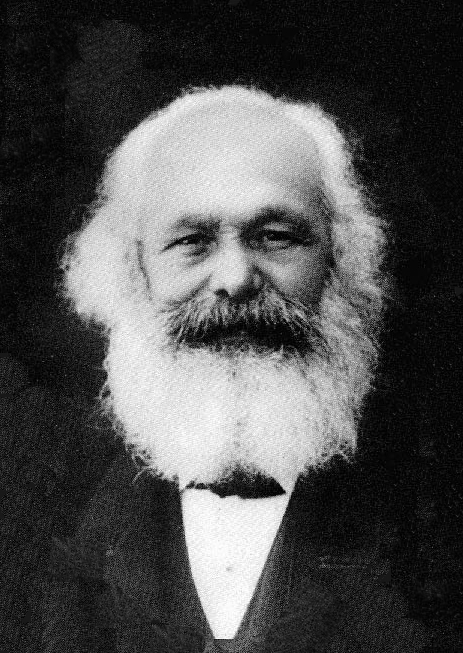
Karl Marx, 1882
What is Marxism and Critical Theory?
Lecture Room, Irish Museum of Modern Art (IMMA) Off-Site at NCH,
Saturday, May 25
Talk: 12:00noon – 1:00pm | What is Marxism and Critical Theory? An Introduction to Marxism and Critical Theory, presented by Declan Long and Francis Halsall, Lecturers, MA Art in the Contemporary World, NCAD.
Panel Discussion: 1.00pm – 2.00pm | Panelists include: Mark Curran (artist and educator), John Molyneux (socialist and activist blogger on Marxist theory and art), Declan Long and Francis Halsall, (Lecturers ACW, NCAD). This panel discussion considers the renewed interest in Marxist theory and its manifestations and relevance for contemporary art theory and practice. This discussion will draw on some of the central ideas addressed in the Intelligence Squared debate, Karl Marx was Right to be screened afterwards. To engage with the content of discussion we advise attendees to view this debate in advance. Please see details below.
Screening: 2.00pm – 3:45pm | Karl Marx was Right
A debate from Intelligence Squared titled Karl Marx was Right, broadcast on Tuesday 9 April 2013 can be viewed below
Booking is essential. Free tickets are available here.
The Breathing Factory at FORMAT 2013, Derby, UK
March 5, 2013 § Leave a comment
I mean we can keep throwing tax breaks at them but that’s just…that will only go so far…it’s a fool’s economy or a false economy or fool’s paradise or whatever you want to call it…I think we need to be…more cost effective and I don’t think…at the moment we really are…what we have got is, as I said, is…a well-trained, educated, kind of workforce…so that’s in our favour, but, again time will tell whether that’s enough…I don’t see it attracting everybody…I think they’ll always come in for the tax break and that’s probably the main reason they’re here for now…so I’m really not sure where this is going to be in 10-15 years time…you could have a lot of well-educated people walking done to the dole office (unemployment office) and you know…but like, I don’t really know where it’s going…you know…
(Cleanroom Supervisor, Canteen, Hewlett-Packard Ireland, 28 November 2003)
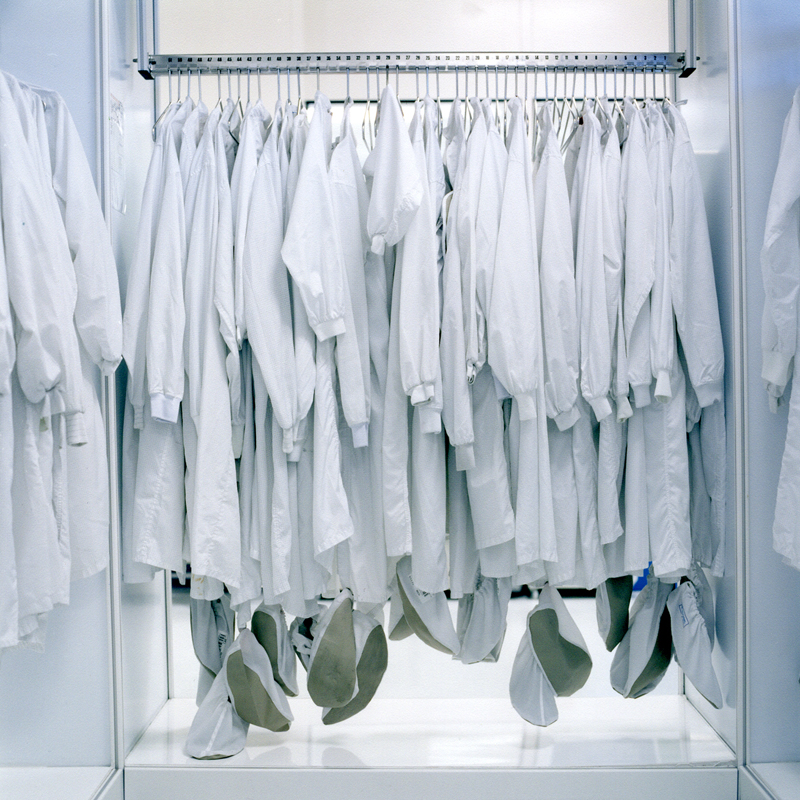
‘Untitled’, Gowning Room, Building 7 11.02 a.m., Monday, November 11th 2003’ (Leixlip, Ireland) 1m x 1cm Ultrachrome Archival Print, Nails, Bullclips
from the project The Breathing Factory (Edition Braus/Belfast Exposed/Gallery of Photography 2006) © Mark Curran
THE BREATHING FACTORY
A project by Mark Curran
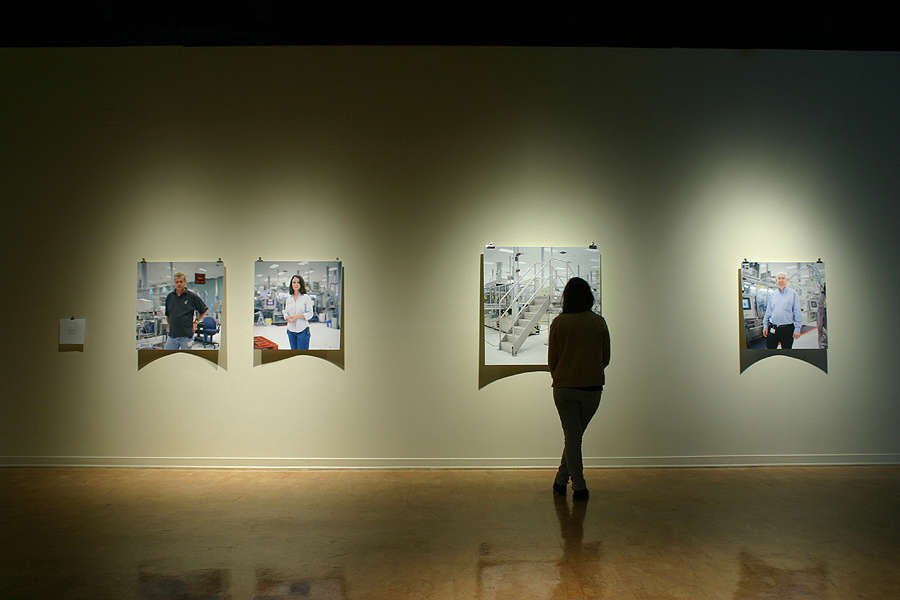
Installation of The Breathing Factory, DePaul Art Museum (DPAM), Chicago, 2010 (image by Dominic Fortunato)
Update: short video clip of the installation at FORMAT 13
Installation of The Breathing Factory, FORMAT13, Derby, UK from Mark Curran on Vimeo.
Steel Works by Julian Germain: ‘a postmodern visual history writing’
January 30, 2013 § 2 Comments
There was a time when to be from Consett was to be almost a celebrity. Catapulted into the media spotlight – photographed and interviewed by every kind of journalist, analysed by economists and sociologists, the subject of television documentaries and academic studies. Now the vast steelworks site, grassed over and landscaped, awaits council inspiration. Of the proposed schemes, which have included a Category A prison, the most bizarre has been a tourist park for the elderly entitled “The Coming Of Age”.
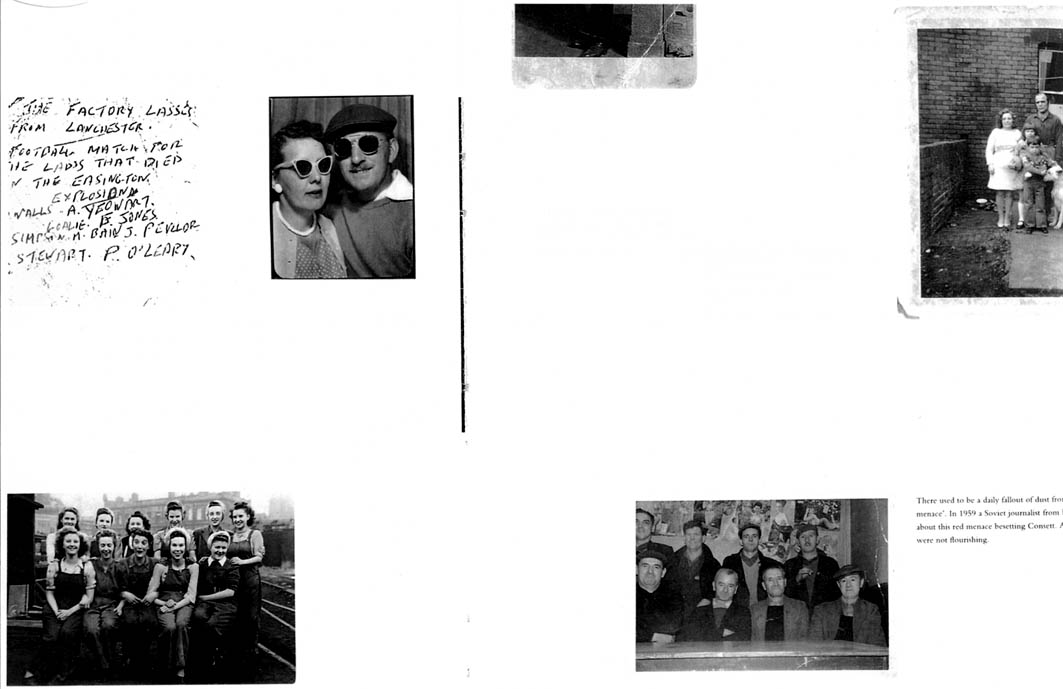
from Steel Works (detail), Julian Germain
The above description originates from the book, Steel Works: Consett, From Steel to Tortilla Chips, published in 1989 to accompany the exhibition of the same title. Funded and presented by the Side Gallery in Newcastle, the project, by the English-born photographer Julian Germain, was a study of Consett in the North of England – ‘a town invented by four well-to-do gentlemen of Tyneside because of accessible mineral resources’27, becoming home to the largest opencast mine and steelworks in Britain. With its closure in the 1980s and the subsequent transformation of the site, the steelworks were completely dismantled involving the largest demolition project ever witnessed in Europe.
Germain employed diverse strategies of representation of the town and its community in order to re-present and re-assert, a sense and semblance of this once vibrant community. A page from Steel Works (above) is open to reveal a two-page, collage-like spread: a holiday photo-booth with a couple bedecked in sunglasses, the family and the family dog in the parent’s backgarden, groups of workers standing and sitting for the photographer, a smoke break, a tea break, and small samples of texts, ‘the factory lassies from Lancaster’ including ‘P. O’Leary’. The images appear haphazardly in display and somehow ‘speak’ to, of and about each other. A sense of a living community is portrayed. However, all are black and white and the clothes look ‘different’. It is not now.
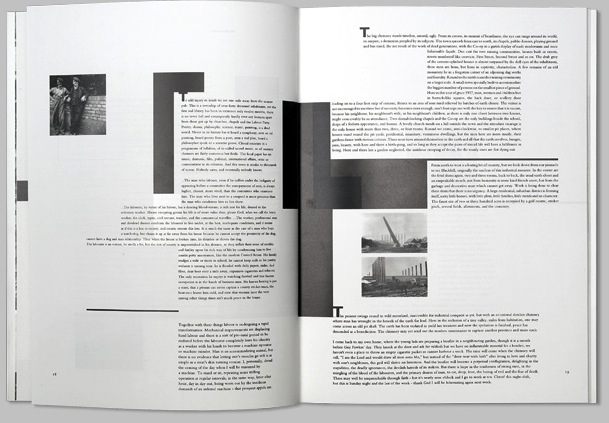
from Steel Works, Julian Germain
Germain presents individual testimony, anecdotes and interviews alongside his use of visual materials (above). We are invited to partake in familial memory by recourse to personal archives and family albums. Displayed alongside, are images by Don McCullin, made for the UK newspaper, The Sunday Times in the 1960s (below).
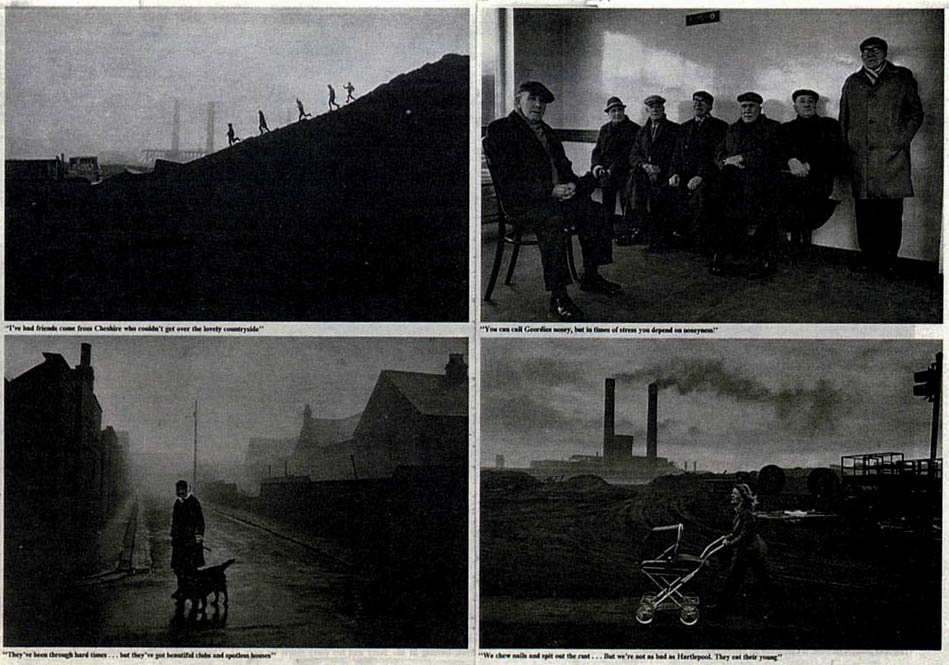
from Steel Works, photographs by Don McCullin
Germain also incorporates the work of another photojournalist, Tommy Harris, a local whom in addition to holding a full-time job at the steelworks, was responsible for photographing the surrounding community for local newpapers in the 1950s and 60s. Harris’s use of a square format camera would mean including details that would later be cropped. Yet, ‘it is these chance elements in Tommy’s uncropped photographs that make his work so revealing’ (quoted from exhibition text).
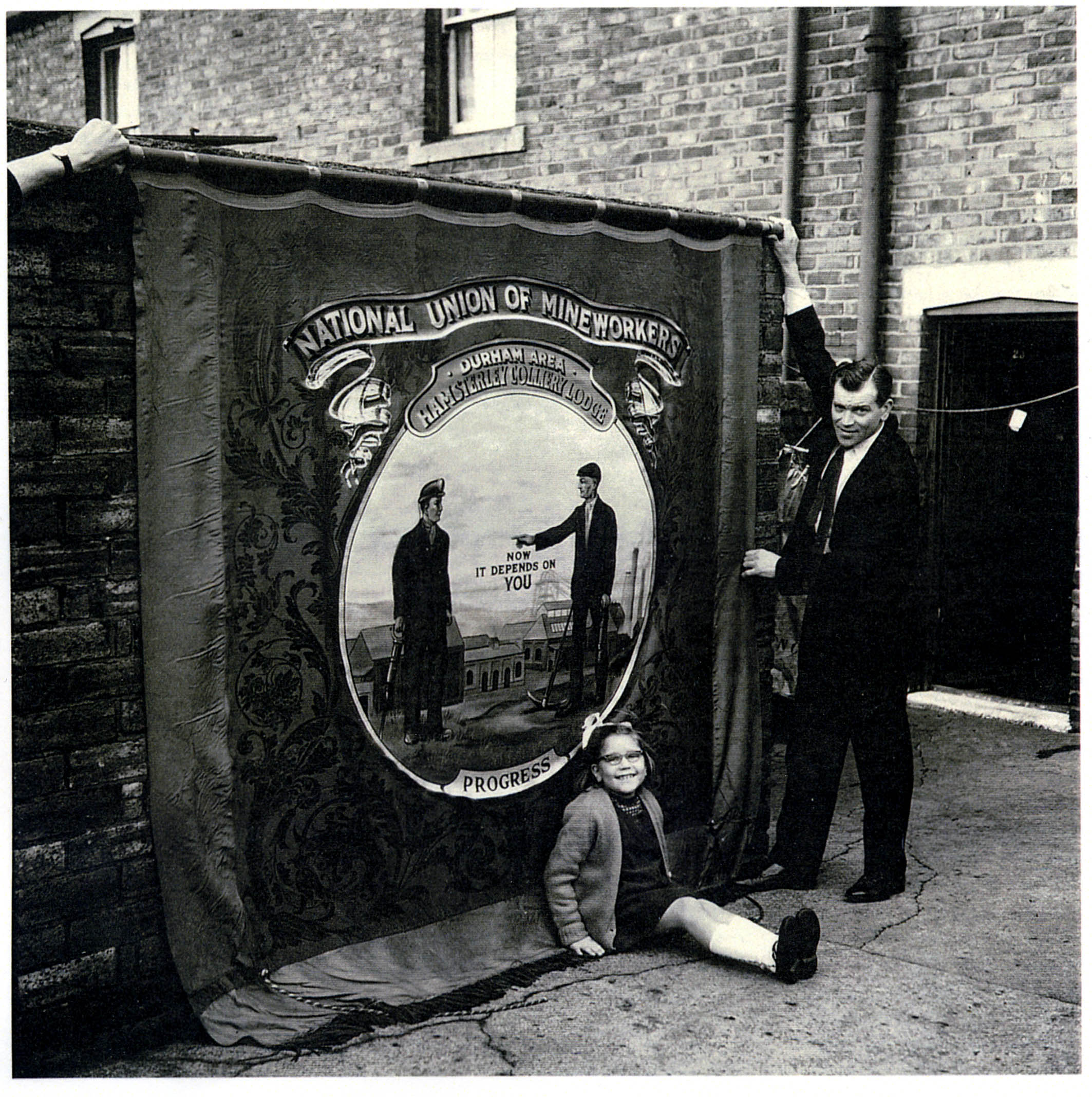
from Steel Works, photograph by Tommy Harris
In the image above , a solitary hand in the upper left hand corner grasps the union workers banner echoing the central motif of solidarity.
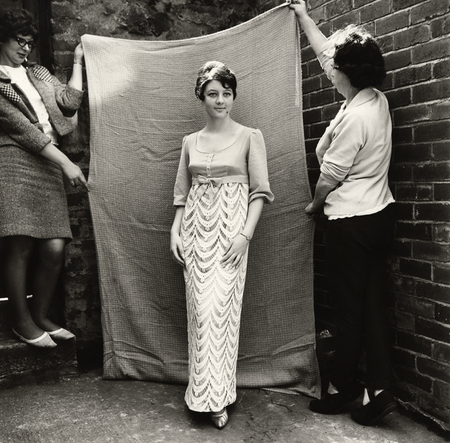
from Steel Works, photograph by Tommy Harris
The two women cling to the bedspread (above), stretched as a backdrop for a picture in the local paper, a daughter or a niece standing gracefully in the backyard. A sense of pride is evoked as both of the older women watch on, accompanied by a sense of purpose in their role, as this younger woman gazes out, towards somewhere. The project also included Germains’ own work in the region from the late 1980s. Through the ‘x’- marked glass of the image below, a labouring man with a carpenter belt shades his eyes and peers outwards and in doing so consciously or unconsciously implicates himself – this glass, t/his reflection, now part of a past or a possible future? As the final paragraph of the press release to accompany the opening of the exhibition, asked:
How do you define a community? The community of Consett has been defined and re-defined throughout its history…changing beyond recognition. The steelworks have been completely dismantled…what identity are people forming for themselves in the new Consett and how do they regard the past?
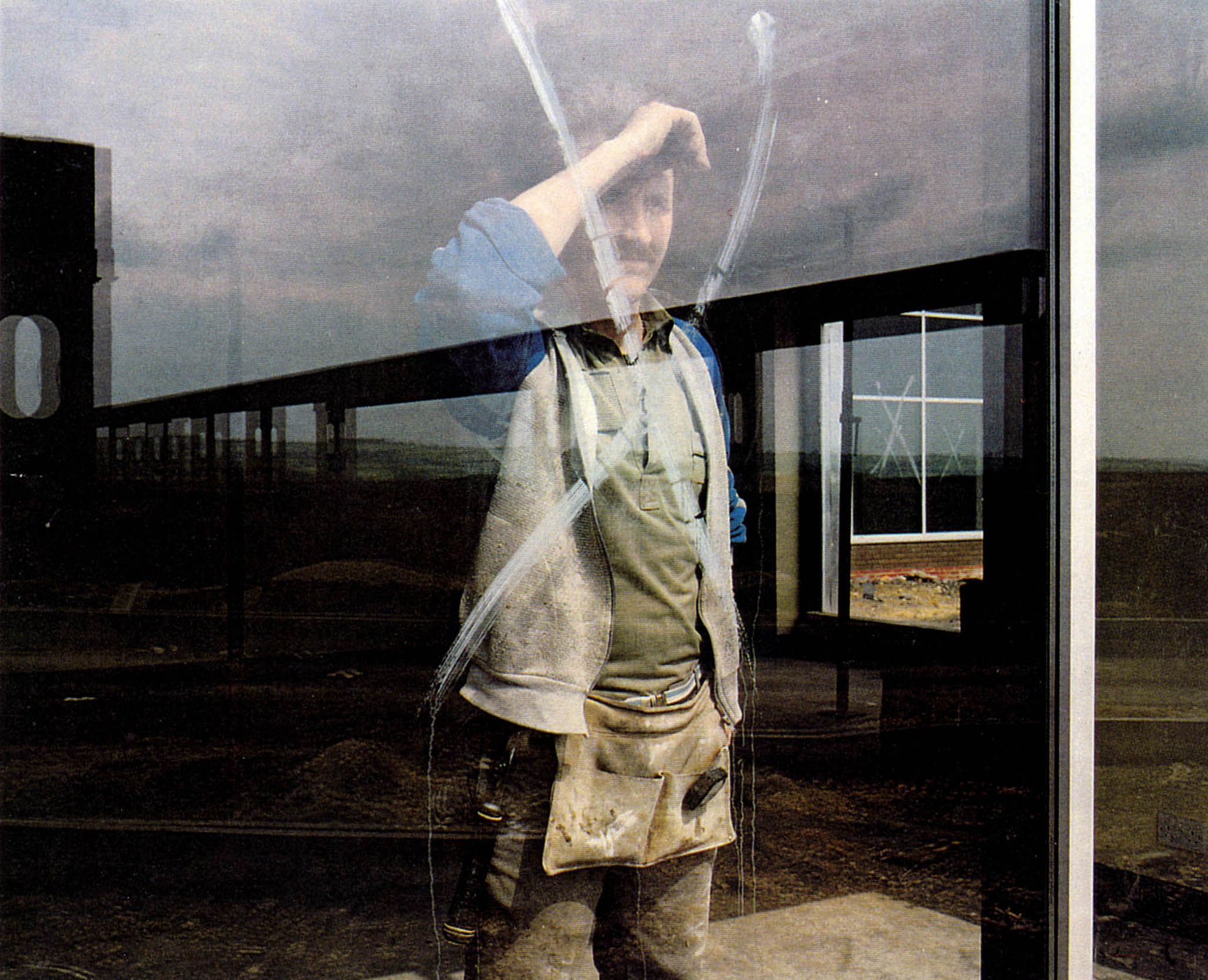
from Steel Works, photograph by Julian Germain
This work, collated by Germain, surveyed a period from 1910 until 1989 and has since been described as a ‘postmodern visual history practice’*. In a location where all physical traces of an industrial past had been removed, Germain constructed a social document of this local working community, through the reconstructive discourse emanating from the diverse representations presented, addressing an identity from the remnants and fragments of its visual and oral histories. More recently, George Baker’s description of the potential of photographs in the projects of the American artist Sharon Lockhart seems relevant and appropriate to the aforementioned projects and practices:
A genetic connection and return is contemplated, and the photographs emerge not so much as statements of appropriation and citation – proper to the debates carried on around photography at earlier moments of postmodernism – but as documents of historical remnants, continuities between past and present, the survival of what seems most precarious and impossible to contemplate in the current historical moment. (2008: 7)
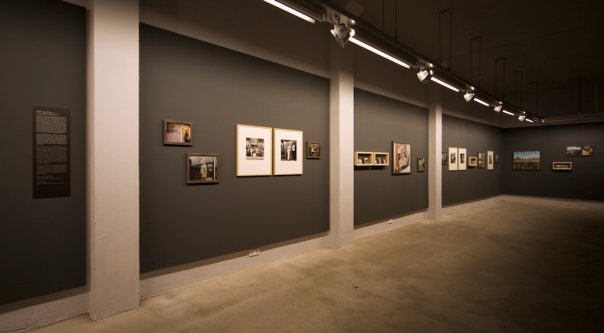
Steel Works (installation view), Multivocal Histories, Noorderlicht Festival, Netherlands, 2009 (image courtesy Noorderlicht)
In 2009, twenty years following its publication, the curator and educator, Bas Vroege, included Steel Works in the exhibition, Multivocal Histories, at the Noorderlicht Festival in the city of Groningen in the Netherlands. Germain’s project was identified by Vroege as the central focal points for the conceptual framing of the exhibition in his selection of the projects included. Drawing on the history of montage, in the ethnographic sense, multivocality, is a critical representational strategy which acknowledges the many voices and multi-linearity of everyday experience in the construction of research. Vroege seeking more hybrid, transdisciplinary and ‘slow’ ways of working, writes in the accompanying catalogue:
Without the intention of doing so, Germain thus gave birth to a photographic practice that could be labelled ‘postmodern visual history writing’. Its essence resides in the fact that no one voice can be authoritative: history is by its nature the product of multiple voices and of recombining records from different moments in time. Or, as Frits Gierstberg recognized in Perspektief No. 41 in 1991: “By juxtaposing different types of photography Germain brings up for discussion their separate claims to authenticity and historical reality within the presentation itself”.
Sources:
*Germain’s practice was described as such in the brochure accompanying a conference titled ‘Work’. This was the inaugural event organised by the International Photography Research Network (IPRN), an initiative of the University of Sunderland, England (9-11 September 2005). Germain was present as a guest speaker
*Quote from text that accompanied the exhibition, ‘Steel Works: Julian Germain’ (Side Gallery, Newcastle, England, 1989)
*Quote from text that accompanied the exhibition, ‘Tommy Harris: Photographs of the County Durham steel town from 1949-1979’ (Side Gallery, Newcastle, England, 2003)
*Baker, G. (2008) ‘Photography and Abstraction’, Los Angeles County Museum of Art, article as part of year long project, WordsWithoutPictures, now available as a publication here
A version of this text was included as part of my practice-led doctorate thesis, the abstract of which can be viewed here
Sonntag presents THE MARKET (a progress report)
January 17, 2013 § 4 Comments
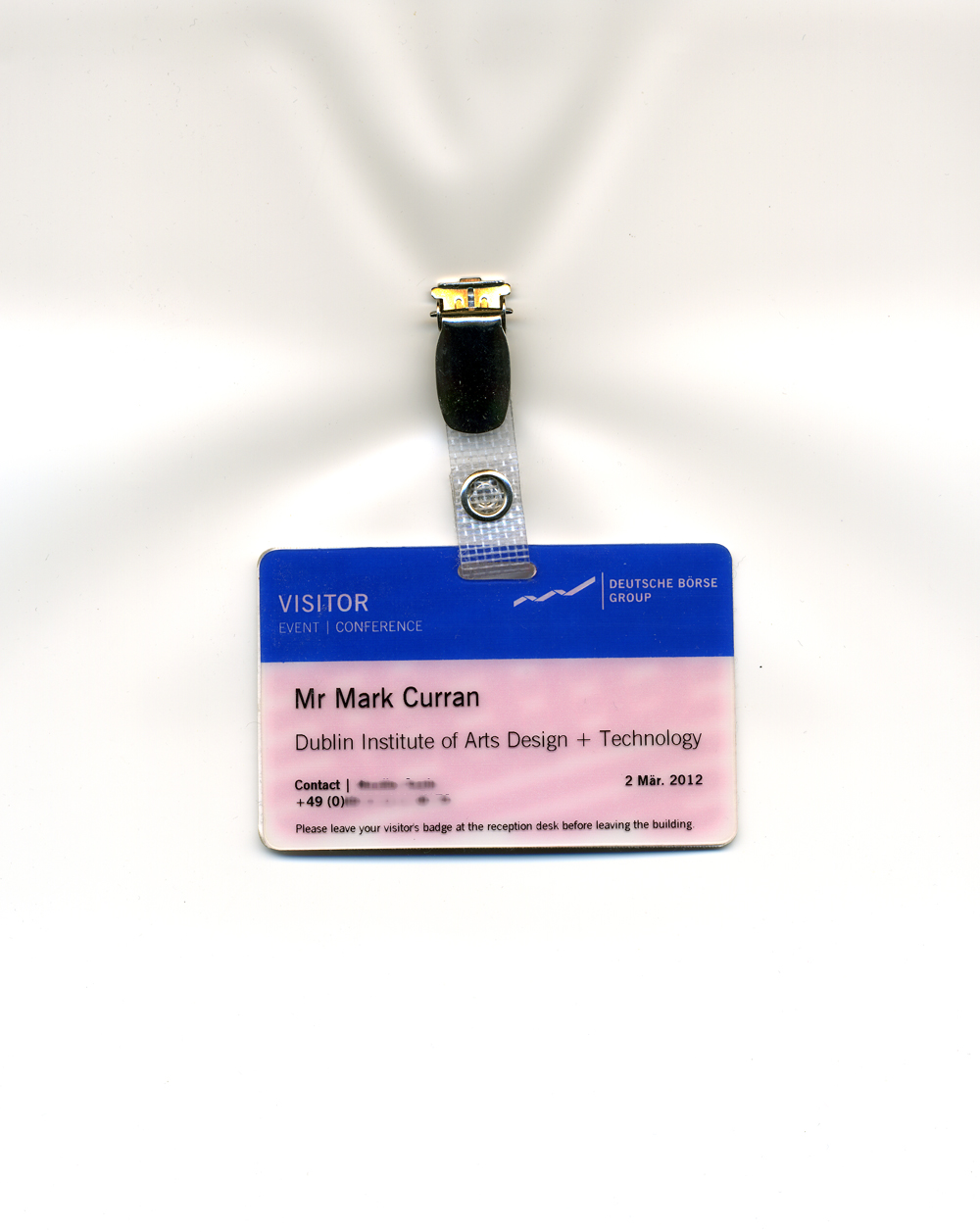
Void Visitors Pass, Deutsche Börse AG, Eschborn, Germany, March 2012
Sonntag would like to invite you to the installation of
THE MARKET (a progress report)*
by Mark Curran
Sunday
20 January
2 – 6pm
Exhibition dates
20 January – 23 January
Gossowstrasse 10, 4. floor
(Bell – Schiesser)
10777 Berlin
U1, U2, U3 Nollendorfplatz
U4 Viktoria – Luise Platz
Sonntag is a social sculpture that invites artists to collaborate and share their work in a domestic space. The project is realized on a monthly basis by way of a public invitation to a Sunday matinee where the invited artist‘s favorite cake and coffee/tea is shared with the audience.
This project was started in September 2012 by Adrian Schiesser and April Gertler.
*The event will feature work in progress from the project, THE MARKET.
Update images of the event can now be found here.
Out Of The Pits: A Gursky Photograph and How to Represent Capital
December 20, 2012 § 2 Comments

Chicago Board of Trade II (1999) by Andreas Gursky
A photograph of a frantic trading pit on an epic scale is installed on a gallery wall, its origins are the largest and oldest commodity exchange in the world. The photograph is titled Chicago Board of Trade II (1999) by German-born photographer, Andreas Gursky. Traversing the globe, Gursky makes images that reflect upon the human condition, as he sees it, manifest in urban, rural, cultural and industrial spaces. Although a former student of Bernd Becher (who worked professionally as an artist with his wife, Hilla Becher) at the Kunstakademie Düsseldorf (Düsseldorf Art Academy), Gursky has not completely subscribed to the dogma of strict objectivity, having always cropped and manipulated negatives when necessary and more recently, incorporated digital manipulation into his practice.
The Chicago Board of Trade is an exemplary site of modernity…in this location, everyday relationships to the potential of money and the necessity of trade become extreme. Financial professionals bring together flow, speed and technology in the pursuit of profits, and when thousands of them gather everyday, they help create something larger – the market.
Installed in a central passageway of London’s Tate Modern, the cultural anthropologist, Caitlin Zaloom, first encountered the image while in the city as part of her long-term ethnographic research on traders. The words quoted above form part of her response to the abstraction of capital that the image invokes, she continues:
a clear message about the velocity of money and its disordering effects in the global economy. The market takes in vast waves of capital and spews them out again in a logic all of its own. Yet the for the crowd of spectators around the photogaph, the commotion and dissarray are entrancing. It is unsettling to examine the picture closely, especially because a literal understanding of the physical space, or of the traders’ labor, is impossible. Instead it is easier to step back from the photograph and absorb the overall impression of the global financial beehive (2010: 2).
Her encounter with Gursky’s photograph forms the introduction to her book, Out of the Pits: Traders and Technology from Chicago to London (2010) and pivotally defines her methodological approach. While, understanding the functioning of such an aesthetic, Zaloom advocates as a priority to move beyond the abstraction of capital, as visually embodied in Gursky’s photograph – a function capital embraces also in the context of technological evolution regarding the labour of the traders themselves and their possible future abstraction – and a necessity, therefore, to look closer and in great detail at the apparatus of the global market:
Markets are objects of inquiry into the culture and economy of contemporary capitalism…today, the world’s powerful financial centers are the ones that need explanation. The mysteries of markets touch our lives, but few outside the financial profession understand them (2010: 11).
 THE MARKET