It’s the Political Economy, Stupid
February 22, 2012 § Leave a comment
A key research concern of the project, Land of the Blind, is the defining relationship between capital and labour. As part of the mandate of this blog is to engage and present material that holds resonance concerning the contemporary context of the thematics which motivated the 1913 Dublin Lockout. Currently on display at the Austrian Cultural Forum New York is a group show curated by Oliver Ressler and Gregory Sholette. The title of the show ‘derives its name from the slogan which in the early 1990s came to define then presidential candidate Bill Clinton’s campaign, “It’s the economy, stupid”’.
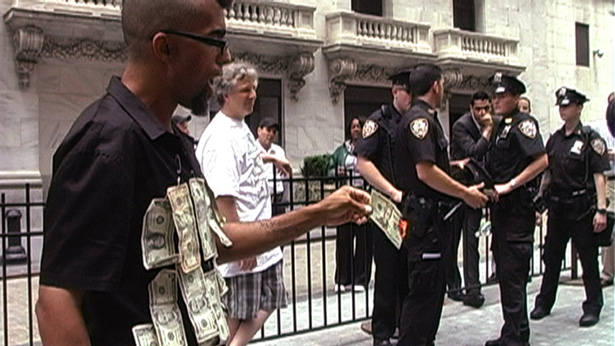
Dread Scott, Still from “Money to burn,” 2010, video.
In light of the present global situation, the curators state:
The economic crisis that we face today has also become a major crisis for representative democracy. The very idea of the modern nation state is in jeopardy as the deterritorialized flow of finance capital melts down all that was once solid into raw material for market speculation. It is the social order itself, and the very notion of governance with its archaic promise of security and happiness that has become another kind of modern ruin.
It’s the Political Economy, Stupid brings together an international group of artists who focus on the current crisis in a sustained and critical manner. Rather than acquiesce to the current calamity, this exhibition asks if it is not time to push back against the disciplinary dictates of the capitalist logic and, by use of artistic means, launch a rescue of the very notion of the social itself.
The artists included are Linda BILDA, Julia CHRISTENSEN, Yevgeniy FIKS / Olga KOPENKINA / Alexandra LERMAN, FLO6x8, Melanie GILLIGAN, Jan Peter HAMMER, Alicia HERRERO, INSTITUTE FOR WISHFUL THINKING, Zanny BEGG / Oliver RESSLER, Isa ROSENBERGER, Dread SCOTT.
The exhibition opened on January 24th and continues until April 22nd, 2012. Details can be found here:
http://www.acfny.org/press-room/press-images-texts/its-the-political-economy-stupid/
THE MARKET a project by Mark Curran
January 9, 2012 § 10 Comments
In the continuing evolutionary aftermath of the global economic collapse of 2008/2009 and absence of sustained practice-led research engagement with the central locus of this catastrophic event, the ethnographically informed, multi-sited, transnational project, THE MARKET (2010-), builds upon the cycle of long-term research projects, beginning in the late 1990s, by practice-led researcher and educator, Mark Curran, and focuses on the functioning and condition of the global markets and the central role of financial capital.
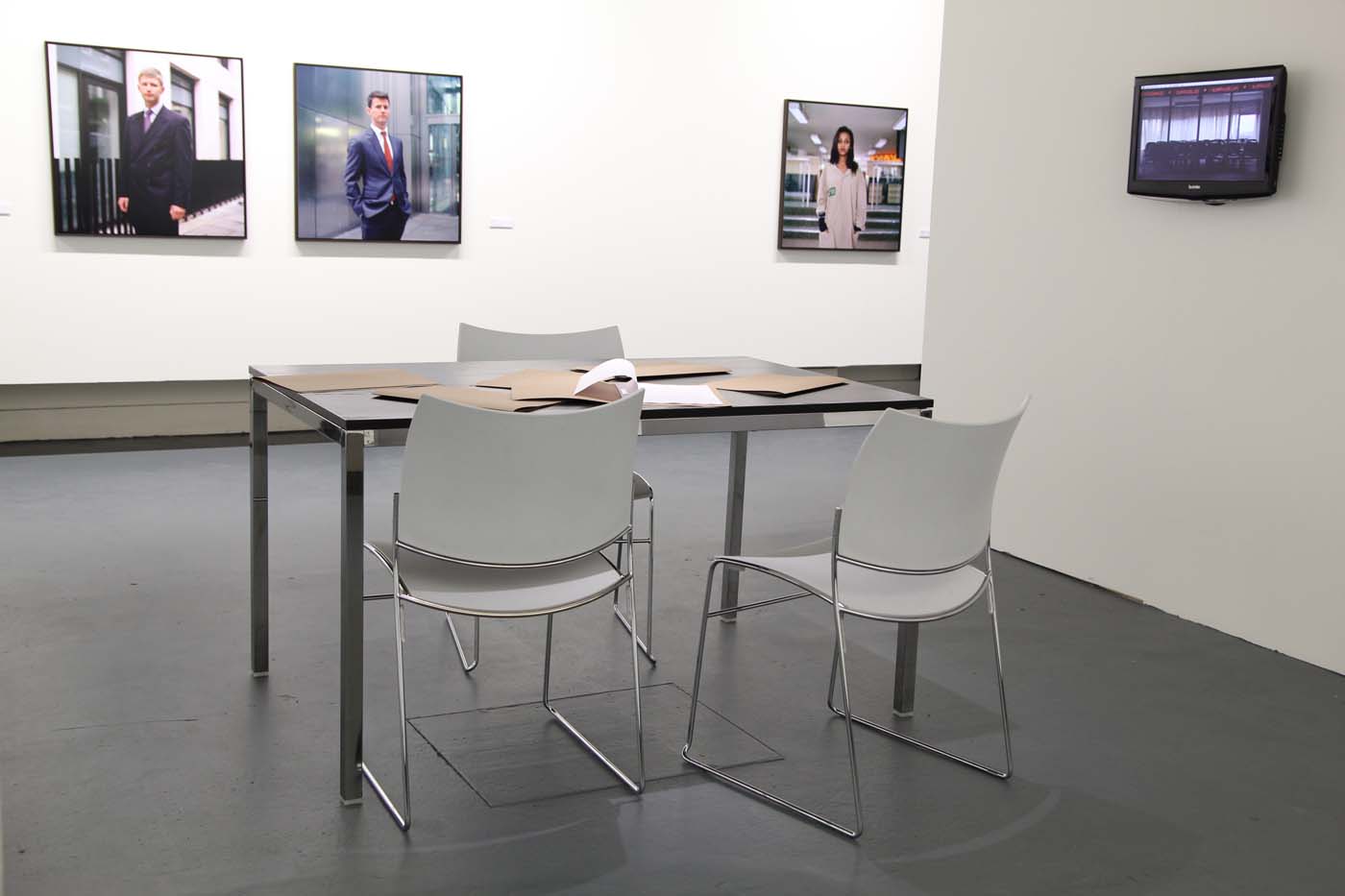
THE MARKET (installation image) Belfast Exposed 2013
The cycle of multi-media research projects, addressing the predatory context resulting from migrations and flows of global capital began with SOUTHERN CROSS (1999-2001)(Gallery of Photography/Cornerhouse 2002) which surveyed the spaces of development and finance of the so-called ‘Celtic Tiger’ Irish Republic. This was followed by The Breathing Factory (2003-2006)(Edition Braus/Belfast Exposed/Gallery of Photography 2006) and subject of his practice-led PhD, sited in a multinational complex in Leixlip in the East of Ireland, the project addressed the role and representation of labour, global labour practices and fragile nature of globalised industrial space. Ausschnitte aus EDEN/Extracts from EDEN (2003-2009)(Arts Council of Ireland, 2011) focused upon a declining industrial and coalmining region in the former East Germany, an area which prophetically evidenced the massive impact regarding the unevenness of development inherent through the functioning of neoliberal globalisation. All projects are intended to demonstrate a continuing and sustained engagement addressing the predatory impact of global capital.
Critically, the ongoing project, THE MARKET, which began in 2010, seeks to access those sites, which all of the other project work to date has also been decisively defined, spaces where literally and metaphorically, futures are speculated upon – the global markets – and to explore, survey and excavate focusing upon their operating functioning and how this is reflected in for example, language, architectural understandings and centrally, the individuals who inhabit, dwell and labour within these global financial spheres. Conceptually pivotal and mindful of technological evolution with specific reference to the role and functioning of algorithms, has been a desire to both make visible an understanding of such sites and to explore the interconnectedness of such markets. Therefore, multi-sited access has been sought to survey various global locations, including sites in Dublin, London, Frankfurt, Addis Ababa and Mumbai. Extended stays and re-visits have been undertaken in each location to facilitate further research regarding the site, address access, establish contacts and develop relationships with individuals as key collaborators and informants of the project.
As demonstrated in Curran’s previous projects, the cross-disciplinary interventions have included an ethnographic understanding in the collaborative and multi-vocal application of media in the form of photography, audio-digital video, soundscape and the collation of verbal testimony. The intention for THE MARKET has been to afford process-led undertakings over the course of its construction, extending to site-specific interventions, web presence and forums around the project installations incorporating interested parties thereby facilitating the opening up of discursive spaces around the central thematic.
In the financial markets, there is a natural predatory instinct that is hard to control (former trader and author, Micheal Lewis, BBC World Service, 9 May 2010)
The video shows a taped up plastic curtain inside the factory, one that seems to be installed for blocking the artist from viewing production equipment and process. Although we cannot see, there seems to be a working (breathing) machine inside the curtain as it, almost unnoticeably, inflates and deflates repetitiously. In fact, the video seems to summate what the audience experiences in the exhibition. The camera made its way inside the factory, but it cannot tell us what the employees actually do or what they produce. We are only allowed to hear the breathe of the factory. This is analogous to today’s globalised economy and financial markets. For many of us, it is almost unfathomable to understand how they operate. We are left outside of a curtain, inside of which a giant machine breathes intermittently. (from Spectators of the Same Story: Economy, Technology, Photography, Jung Joon Lee, Review of The Breathing Factory: A Project by Mark Curran, DePaul Art Museum (DPAM), Chicago January-March 2010, CAMERAta, Seoul, Korea, May 2010)
Keywords Global Capital, Ethnography, Photography, Speculation, Transnational, Vulnerable, Fieldwork, Precarity, Testimony, Cross-disciplinary, Labour, Witness, Reflexive, Installation, Montage, Multivocality, Access, Technology, Algorithms, Visual Art, Futures
 THE MARKET