The Bull Laid Bear
August 21, 2012 § Leave a comment

(The Bull Laid Bear (film still by Begg and Ressler, 2012)
This year’s Eva International, the artist-centered biennale held in Limerick, Ireland was guest curated by Annie Fletcher. Thematically titled, After The Future, the city-wide event sought to ‘to examine how certain artistic practices provide an active invocation of the present and speculate how we arrived here in the first place. This collaborative and multifaceted project takes as its point of departure the media theorist and activist Franco “Bifo” Berardi’s book, After The Future (AK Press, 2011), considering his admonishment of economic futurisms and advocacy for living slowly in the infinite present’. As Fletcher, Curator of Exhibitions at the Van Abbemuseum in Eindhoven, The Netherlands, elaborates:
Everywhere we look and everything we read right now seems to tell us we are at a new juncture. We are at an unprecedented moment of change – whether teetering on the edge of a financial precipice, or witnessing extraordinary new articulations of protest. This year eva International will attempt to tap into this feeling of immanence by understanding how artists define and explain the status quo in relation to global events. What are we on the verge of? How do artists envisage what is to come and what is to be done?

The Bull Laid Bear (film still by Begg and Ressler, 2012)
One of the central installations was the collaborative project, The Bull Laid Bear, by cross-disciplinary artists, Zanny Begg and Oliver Ressler. This 24 minute film, using interviews with economists and activists in the United States interspersed with animation and drawings and in the words of the authors:
‘lays bare’ the economic recession (bear market) that hides behind each boom time (bull market). The film pokes fun at the slippery justifications made for the bailouts and austerity packages by exploring how governments in the United States, and other countries such as Ireland, turned a banking crisis into a budgetary crisis at the governmental level.
Significant in both format and insight offered, a short clip can be viewed here.
‘Predatory Mobility’
August 13, 2012 § Leave a comment
‘Global capital in its contemporary form is characterised by strategies of predatory mobility (across both time and space) that have vastly compromised the capacities of actors in single locations even to understand, much less anticipate or resist, these strategies. Though states…vary in how and whether they are mere instruments of global capital, they have certainly been eroded as sites of political, economic and cultural sovereignty’
(Arjun Appadurai (2001), ‘Grassroots Globalisation and the Research Imagination’ in Globalisation, Duke University, p. 18)
Summer Interns Having Lunch (1987)
July 18, 2012 § Leave a comment

Summer Interns Having Lunch, Wall Street, New York, 1987 (photograph by Joel Sternfeld)
Described as a pioneer of colour photography, Joel Sternfeld, lives and works in New York. This image by Sternfeld from 1987 focuses upon the youthful summer intern, a role defined as a crucial and critical rite of passage for those who desire a future on the street. Significant is also the timing of the photograph as it precedes the stock market crash of Black Monday that Autumn, viewed by many as a result of the increasing prevalence of neoliberal financial capitalism and the rising application of computer trading, particularly in the United States.
(Installation) Ausschnitte aus EDEN/Extracts from EDEN – PhotoIreland 2012
July 8, 2012 § 2 Comments
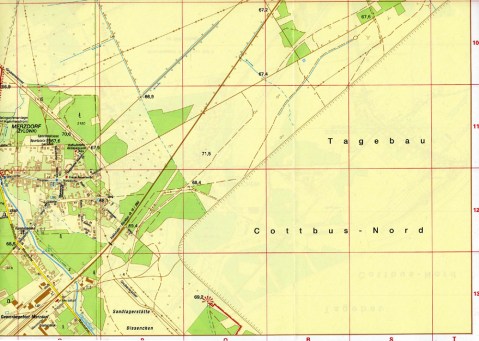
‘untitled’, section(map), Cottbus, Lausitz, Eastern Germany (glass slide, single projection)
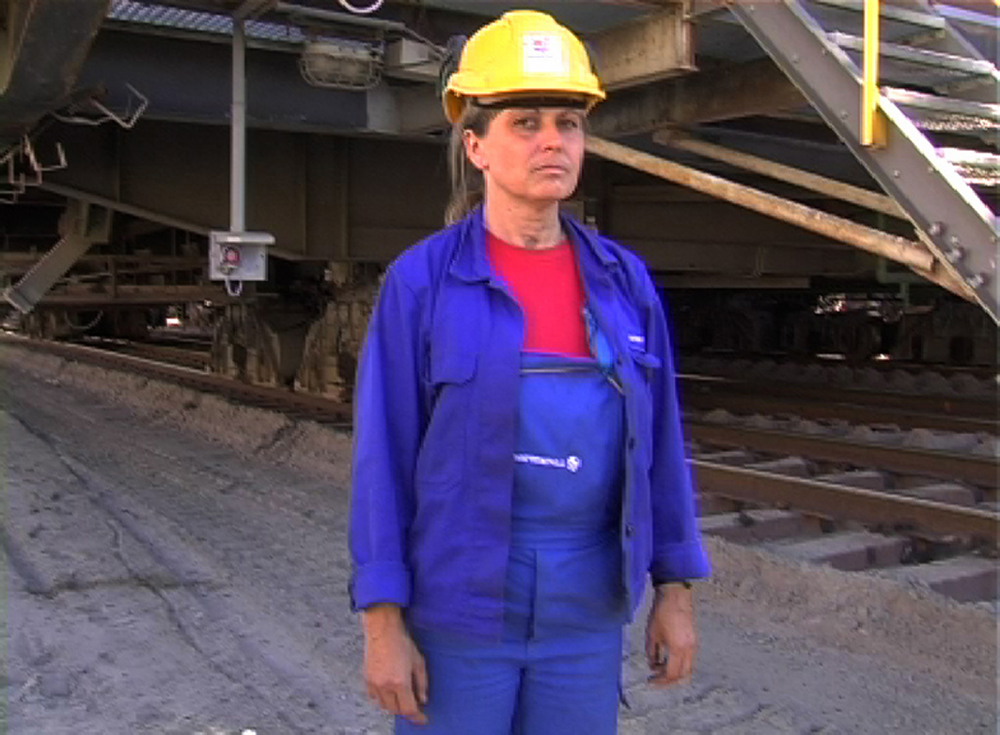
Angelika, Tagebauarbeiterin, Tagebau Jaenschwalde, Lausitz, Eastern Germany, July 2008 (still, two-channel digital video, looped)
Having first visited the region in late 2003, seeking the impact of global capital in a periphery of Europe, as had been experienced in my native Ireland, I quickly realised that it was in fact the antithesis of this experience. Prior to the global economic collapse, but as evidenced by the above prophetic words of Marco, I encountered an emptying and the recognition that the same globalising forces which had transformed unrestrained the landscape of my origins, were indeed transforming this landscape through its forces of withdrawal and seepage – a globalised hemorrhaging. As a result, jobs were and continue to go further East while its younger population migrates to the West and in 2007, the Lausitz came last in a national survey addressing future prospects.
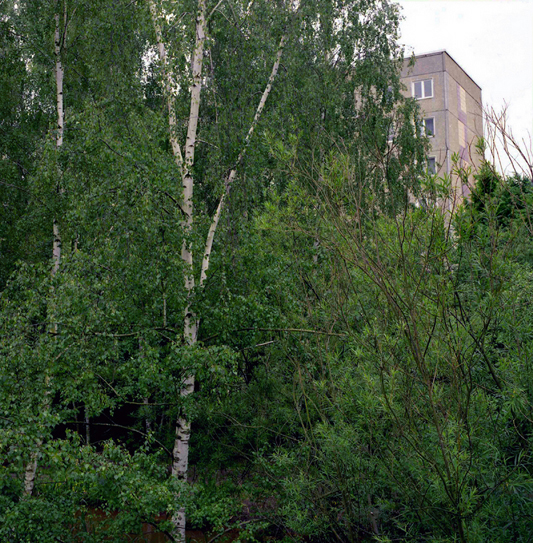
‘untitled’ (empty housing project in process of being dismantled), Neu Schmellwitz, Cottbus, Lausitz, Eastern Germany, August 2007 (glass slide, single projection
Informed by ethnographic understandings and incorporating audio digital video, photography, cross-generational testimony and artefactual material, the project has been constructed in the context of a landscape shaped by and inscribed with the utopic ideological aspirations of modernity – industrialisation, socialism and now at great cost, globalisation. In totality, the region invokes Marshall Berman’s ‘wounds of modernity’ resulting from the ‘cycles of destruction’ necessary for the functioning of capital. A pivotal emphasis for the project, is the catalyst for the region itself, the Tagebau and critically viewing it as perhaps a metaphor for late capitalism – finite, fragile and ultimately, unsustainable.
The production of the project has been generously supported by the Arts Council of Ireland.
Further information and location of exhibition available here.
Video documentation of the installation of the project as part of Encontros da Imagem in Braga, Portugal in 2011 can be viewed here.

Ausschnitte aus EDEN/Extracts from EDEN (installation image, Braga, Portugal, 2011, photograph courtesy Jorge Inacio)
Normalisation of Deviance
July 5, 2012 § 1 Comment
Algorithmic Trading or High Frequency Trading or Black Box Trading according to a new report by the British Government’s Office for Science, Foresight, is set to replace Human Trading in the global stock markets. This form of trading is undertaken through decisions made by computers, primarily based upon large volumes of information/data related to previous market behaviour. In 2007, 50% of all equity trading in the United States was undertaken via algorithms and at present, this is 75%. In Europe, it is presently 40%.
The Future of Computer Trading in Financial Markets (Foresight, Goverment Office for Science, UK 2012)(cover)
In the working paper, titled, The Future of Computer Trading in Financial Markets (the full report is due at the end of 2012), the research project outlines the benefits and costs of such processes. The authors describes how in a decade, algorithms will be able to essentially self evolve through their ability to ‘experience’ i.e. building upon their previous market experiences and therefore requiring no human intervention. However, they do warn, that within such a framework, there exists the potential for what they describe as ‘instability’ through the Normalisation of Deviance which they identify as when ‘unexpected and risky events come to be seen as ever more normal (eg. extremely rapid crashes), until a disaster occurs’
We’re running through the United States with dynamite and rock saws so that an algorithm can close the deal three microseconds faster, all for a communications framework that no human will ever know; that’s a kind of manifest destiny.
The above words by Kevin Slavin were made in relation to the present construction of a high-speed fibre-optic cable between Chicago and New York to facilitate black box trading and comes from his TED talk titled, How Algorithms Shape Our World. Addressing some of the thematics outlined in the Foresight working paper. Slavin, a designer and consultant in the field of technology, argues, ‘that we’re living in a world designed for, and increasingly controlled by, algorithms’, and through the course of his presentation shows ‘how these complex computer programs determine espionage tactics, stock prices, movie scripts, and architecture’. Critically, Slavin warns how ‘we are writing code we can’t understand, with implications we can’t control’.
Between Nature and Culture: Photography as Mediation and Method
June 24, 2012 § Leave a comment

From the series Beneath the Surface / Hidden Place 2007-10. Nicky Bird & Jan McTaggart: Foxbar, Paisley (Back of Annan Drive, 1977?/Back of Springvale Drive, 2007)
BETWEEN NATURE AND CULTURE: Photography as Mediation and Method
Symposium on Friday, June 29th, 2012
16 – 18 Ramillies Street,
London W1F 7LW
‘While we commonly expect photography to have a close relationship with the real, many practices positively engage with memory, landscape, identity and narrative. These themes rely heavily on photography as a means of translation and storytelling. This symposium invites theorists and photographers to speak about how they work with photography as a practice that serves to mediate the real’
Speakers include Ej Major, Nicky Bird and Mark Curran.
Organised by Dr Anne Burke and Dr Damian Sutton, Middlesex University.
1.30pm until 6pm
Further information can be found here
Contact: +44 (0)20 7087 9300/
Duty and Distraction
June 20, 2012 § Leave a comment
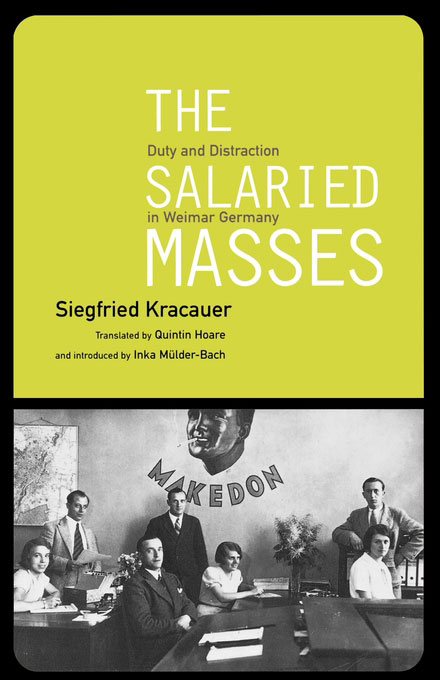
Die Angestellten: Aus den neuesten Deutschland/The Salaried Masses: Duty and Distraction in Weimar Germany by Siegfried Kracauer (front cover, Verso edition, 1998)
Published in 1930, Die Angestellten: Aus den neuesten Deutschland/ The Salaried Masses: Duty and Distraction in Weimar Germany by the writer and theorist, Siegfried Kracauer, was critically acclaimed. His friend and fellow author, Walter Benjamin, wrote, ‘ the entire book is an attempt to grapple with a piece of everyday reality, constructed here and experienced now. Reality is pressed so closely that it is compelled to declare its colors and name names’. Kracauer sought to address the new class of salaried employees of the Weimar Republic:
Spiritually homeless, divorced from all custom and tradition, these white-collar workers sought refuge in entertainment—or the “distraction industries,” as Kracauer put it—but, only three years later, were to flee into the arms of Adolf Hitler. Eschewing the instruments of traditional sociological scholarship, but without collapsing into mere journalistic reportage, Kracauer explores the contradictions of this caste. Drawing on conversations, newspapers, adverts and personal correspondence, he charts the bland horror of the everyday. In the process he succeeds in writing not just a prescient account of the declining days of the Weimar Republic, but also a path-breaking exercise in the sociology of culture which has sharp relevance for today.
Informed by sociology and discourse of the cinema, the publication was innovative both methodologically, for what could be described as its anticipated ‘ethnographicness’ and the resulting representational strategies of the ‘montage principle’. Kracauer employed a hybrid-like approach including ‘quotation, conversation, report, narrative, scene, image’ and as Inka Muelder-Bach, in her introduction to the English edition, observes:
His investigation…refrains from formulating its insight in a conceptual language removed form its material. Instead, Kracauer seeks to construct in that material. In other words, knowledge of the material’s significance becomes the principle of its textual representation, so that the representation itself articulates the theory.
The significance of its representational structure as means to articulate the everyday of ‘salaried employees’ material living conditions and that of the ideologies superimposed on this reality’ make it a important publication of continuing critical resonance.
All That Is Solid Melts Into Air
June 5, 2012 § Leave a comment
With a title originating from The Communist Manifesto by Karl Marx, All That Is Solid Melts Into Air is a visual art project by American-born, Amsterdam-based artist, Mark Boulos which seeks to address Marx’s notion of ‘commodity fetishism…where commodities seem to possess metaphysical qualities rather than material…(thereby) obscuring the labour relations which produce and distribute them’.

All That Is Solid Melts Into Air (film still) by Mark Boulos 2008
Boulos decided to focus on one of the most important commodities, oil and its ‘two end points, production and distribution’. He travelled to Nigeria and the Niger Delta, one of the most important oil producing regions on the continent of Africa and filmed Movement for the Emancipation of the Niger Delta (MEND). The Niger Delta is noted for its extreme poverty in spite of the region’s oil wealth and the miltant group seeks to redistribute that available wealth. Subsequently, Boulos then filmed at the Chicago Mercantile Exchange, one of the largest commodity exchanges in the world and which trades in commodities including oil futures.
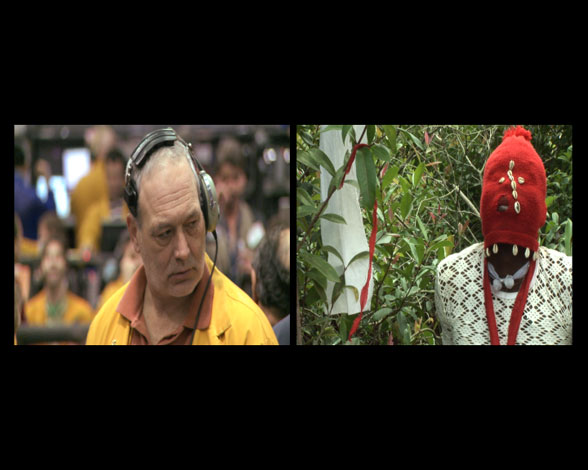
All That Is Solid Melts Into Air (film still) by Mark Boulos 2008
First shown in 2008, it has been widely presented including the 2010 Berlin Biennale amongst others and is presently installed at the Museum of Modern Art in New York. In this interview, from 2008, with the Stedelijk Museum in Amsterdam, Boulos states how the majority of his work critically addresses ‘the relationship between ideas and material reality’.
The project takes the form of a two-screen installation, facing each other, the viewer is placed in between. Unable to fully view or engage with either film simultaneously, the viewer is required to make ongoing and repeated decisions in terms of a commitment regarding which way to look. Through its presentational strategy, the project appears to ceaselessly confront, not only those portrayed on the two screens, but those who perhaps find themselves in the middle.
M-SCOPES – MEDIATED SIGNIFICATIONS IN FINANCE
May 17, 2012 § 1 Comment
While presenting recently at the conference, Photomedia 2012-Images in Circulation, organised by the Aalto University of Arts, Design and Architecture in Helsinki, I managed to hear the research presentation by Yrjö Tuunanen, titled, Visualising the Economy – Visual Representations of Financial News. Yrjö is a doctoral student in the Department of Media at the university where his research interests include visual communication, multimodal discourse analysis, social semiotics with a special interest in financial news discourses mediated in the news media. His presentation was further informed as a result of his role, along with Dr. Heidi Hirsto in the transnational research project, M-Scopes – Mediated Significations of Finance, a collaborative undertaking including the Parsons The New School for Design, New York and the National University of Singapore:
M-Scopes is a collaborative research initiative focusing on the ways in which economic phenomena and mechanisms are visually reproduced in multimodal electronic news media.
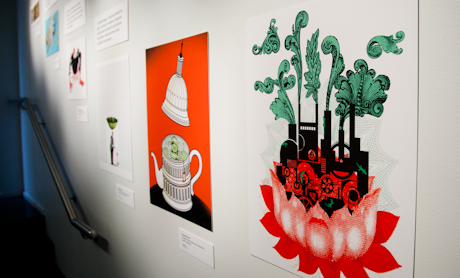
‘Visualising Finance Lab’, Aalto University, Helsinki, May 2012 (Installation image)
A core component of the project took the form of a two-day seminar recently held in Helsinki which included an accompanying installation. Described as addressing the ‘confusion and loss, emotion, metaphor, and design process in the communication of financial concepts’, the exhibition had particular interest ‘in the power of metaphor to access the emotions that inform financial behaviors’.
The research project continues and an accompanying blog has been established providing updates and engagements with the discourse of media representation of finance, exemplified in this entry, Encounters in Multisemiotic Economy. At this critical global moment, M-Scopes forms a significant entry point to a number of international projects critically addressing the media representation of finance, also a key framing concern for Land of the Blind
 THE MARKET